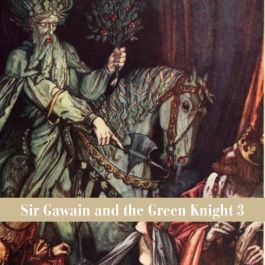
Thanks again to Thomas Copeland and his Librivox team.
The editor of the version which Copeland is reading for us has a footnote here which is of value to us: In part it reads: “The account of each day’s hunting contains a number of obsolete terms and details of woodcraft, not given in full. The meaning of some has been lost, and the minute description of skinning and dismembering the game would be distinctly repulsive to the general reader. They are valuable for a student of the history of the English sport, but interfere with the progress of the story. The fact that the author devotes so much space to them seems to indicate that he lived in the country and was keenly interested in field sports.”
Full early, ere daylight, the folk rose up; the guests who would depart called their grooms, and they made them ready, and saddled the steeds, tightened up the girths, and trussed up their mails. The knights, all arrayed for riding, leapt up lightly, and took their bridles, and each rode his way as pleased him best.
The lord of the land was not the last. Ready for the chase, with many of his men, he ate a sop hastily when he had heard Mass, and then with blast of the bugle fared forth to the field.10 He and his nobles were to horse ere daylight glimmered upon the earth.
A sop is a piece of bread dipped in something. Wine and gravy are popular.
Then the huntsmen coupled their hounds, unclosed the kennel door, and called them out. They blew three blasts gaily on the bugles, the hounds bayed fiercely, and they that would go a-hunting checked and chastised them. A hundred hunters there were of the best, so I have heard tell. Then the trackers gat them to the trysting-place and uncoupled the hounds, and forest rang again with their gay blasts.
A lot of people who comment on this passage seem to suggest that the hounds are coupled in the sense of being put in teams of two, like gunhounds. I’d like to suggest that they are “coupled” in the sense that they are put on a leash, because later they are “uncoupled” before the hunt begins. This translation later calls them greyhounds. There are greyhounds in Britain after the Romans, so…perhaps.
The modern English word “tryst” comes from a Scots Gaelic word which means “meeting place for hunting”.
At the first sound of the hunt the game quaked for fear, and fled, trembling, along the vale. They betook them to the heights, but the liers in wait turned them back with loud cries; the harts they let pass them, and the stags with their spreading antlers, for the lord had forbidden that they should be slain, but the hinds and the does they turned back, and drave down into the valleys. Then might ye see much shooting of arrows. As the deer fled under the boughs a broad whistling shaft smote and wounded each sorely, so that, wounded and bleeding, they fell dying on the banks. The hounds followed swiftly on their tracks, and hunters, blowing the horn, sped after them with ringing shouts as if the cliffs burst asunder. What game escaped those that shot was run down at the outer ring. Thus were they driven on the hills, and harassed at the waters, so well did the men know their work, and the greyhounds were so great and swift that they ran them down as fast as the hunters could slay them. Thus the lord passed the day in mirth and joyfulness, even to nightfall.
The style of hunting here, which I thought was called “driving” but apparently that’s an Americanism, is just called “hunting” and differentiated by calling personal pursuit “stalking”. The drivers push the herd through a narrow gorge that acts as a kill zone. In the US this sometimes was deliberately into a river or lake, and the hunters were in boats, because swimming stags can’t kick you or stab with their horns properly. Then again, the Americans were hunting for food and profit. That’s considered not quite the thing among the European nobility, who instead use peasants and dogs.
This is a winter hunt, to reduce the herd to prevent starvation by spring, and top up supplies over the Christmas season. Here they let the males go and shoot the females This seems an odd way to manage a herd and I’m not sure why you’d do this. I’ve heard of kings saying only they or their honoured guests are allowed to kill stags with prongs above a certain number. There may be something symbolic I’m missing here, but why you’d kill the lighter females, with less meat and fat, and capable of calving, and spare the harts, mature males that are not stags, is a mystery to me. Comments on the blog very welcome.
So the lord roamed the woods, and Gawain, that good night, lay ever a-bed, curtained about, under the costly coverlet, while the daylight gleamed on the walls. And as he lay half slumbering, he heard a little sound at the door, and he raised his head, and caught back a corner of the curtain, and waited to see what it might be. It was the lovely lady, the lord’s wife; she shut the door softly behind her, and turned towards the bed; and Gawain was shamed, laid him down softly and made as if he slept. And she came lightly to the bedside, within the curtain, and sat herself down beside him, to wait till he wakened. The knight lay there awhile, and marvelled within himself what her coming might betoken; and he said to himself, “‘Twere more seemly if I asked her what hath brought her hither.” Then he made feint to waken, and turned towards her, and opened his eyes as one astonished, and crossed himself; and she looked on him laughing, with her cheeks red and white, lovely to behold, and small smiling lips.
“Good morrow, Sir Gawain,” said that fair lady; “ye are but a careless sleeper, since one can enter thus. Now are ye taken unawares, and lest ye escape me I shall bind you in your bed; of that be ye assured!” Laughing, she spake these words.
As a modern reader, may I note that the seduction scene begins with an offer of light bondage? How clear was that to readers near the time of writing? I have no idea. The notes I’ve read about this scene, oddly, don’t much mention the lady offering to tie the underdressed Gawain to his bed for her pleasure.
“Good morrow, fair lady,” quoth Gawain blithely. “I will do your will, as it likes me well. For I yield me readily, and pray your grace, and that is best, by my faith, since I needs must do so.” Thus he jested again, laughing. “But an ye would, fair lady, grant me this grace that ye pray your prisoner to rise. I would get me from bed, and array me better, then could I talk with ye in more comfort.”
“Nay, forsooth, fair sir,” quoth the lady, “ye shall not rise, I will rede ye better.
“Rede” here, R E D E, means “advise”. It also means to interpret a puzzle or dream: take note Criamon magi.
I shall keep ye here, since ye can do no other, and talk with my knight whom I have captured. For I know well that ye are Sir Gawain, whom all the world worships, wheresoever ye may ride. Your honour and your courtesy are praised by lords and ladies, by all who live. Now ye are here and we are alone, my lord and his men are afield; the serving men in their beds, and my maidens also, and the door shut upon us. And since in this hour I have him that all men love, I shall use my time well with speech, while it lasts. Ye are welcome to my company, for it behoves me in sooth to be your servant.”
“In good faith,” quoth Gawain, “I think me that I am not him of whom ye speak, for unworthy am I of such service as ye here proffer. In sooth, I were glad if I might set myself by word or service to your pleasure; a pure joy would it be to me!”
“In good faith, Sir Gawain,” quoth the gay lady, “the praise and the prowess that pleases all ladies I lack them not, nor hold them light; yet are there ladies enough who would liever now have the knight in their hold, as I have ye here, to dally with your courteous words, to bring them comfort and to ease their cares, than much of the treasure and the gold that are theirs. And now, through the grace of Him who upholds the heavens, I have wholly in my power that which they all desire!”
Thus the lady, fair to look upon, made him great cheer, and Sir Gawain, with modest words, answered her again: “Madam,” he quoth, “may Mary requite ye, for in good faith I have found in ye a noble frankness. Much courtesy have other folk shown me, but the honour they have done me is naught to the worship of yourself, who knoweth but good.”
“By Mary,” quoth the lady, “I think otherwise; for were I worth all the women alive, and had I the wealth of the world in my hand, and might choose me a lord to my liking, then, for all that I have seen in ye, Sir Knight, of beauty and courtesy and blithe semblance, and for all that I have hearkened and hold for true, there should be no knight on earth to be chosen before ye!”
“Well I wot,” quoth Sir Gawain, “that ye have chosen a better; but I am proud that ye should so prize me, and as your servant do I hold ye my sovereign, and your knight am I, and may Christ reward ye.”
So they talked of many matters till mid-morn was past, and ever the lady made as though she loved him, and the knight turned her speech aside. For though she were the brightest of maidens, yet had he forborne to shew her love for the danger that awaited him, and the blow that must be given without delay.
Then the lady prayed her leave from him, and he granted it readily. And she gave [the text reads “have”] him good-day, with laughing glance, but he must needs marvel at her words:
“Now He that speeds fair speech reward ye this disport; but that ye be Gawain my mind misdoubts me greatly.”
“Wherefore?” quoth the knight quickly, fearing lest he had lacked in some courtesy.
A reminder that “wherefore?” means “why?” not “where?”.
And the lady spake: “So true a knight as Gawain is holden, and one so perfect in courtesy, would never have tarried so long with a lady but he would of his courtesy have craved a kiss at parting.”
Then quoth Gawain, “I wot I will do even as it may please ye, and kiss at your commandment, as a true knight should who forbears to ask for fear of displeasure.”
At that she came near and bent down and kissed the knight, and each commended the other to Christ, and she went forth from the chamber softly.
Then Sir Gawain arose and called his chamberlain and chose his garments, and when he was ready he gat him forth to Mass, and then went to meat, and made merry all day till the rising of the moon, and never had a knight fairer lodging than had he with those two noble ladies, the elder and the younger.
And even the lord of the land chased the hinds through holt and heath till eventide, and then with much blowing of bugles and baying of hounds they bore the game homeward; and by the time daylight was done all the folk had returned to that fair castle. And when the lord and Sir Gawain met together, then were they both well pleased. The lord commanded them all to assemble in the great hall, and the ladies to descend with their maidens, and there, before them all, he bade the men fetch in the spoil of the day’s hunting, and he called unto Gawain, and counted the tale of the beasts, and showed them unto him, and said, “What think ye of this game, Sir Knight? Have I deserved of ye thanks for my woodcraft?”
“Yea, I wis,” quoth the other, “here is the fairest spoil I have seen this seven year in the winter season.”
“And all this do I give ye, Gawain,” quoth the host, “for by accord of covenant ye may claim it as your own.”
“That is sooth,” quoth the other, “I grant you that same; and I have fairly won this within walls, and with as good will do I yield it to ye.” With that he clasped his hands round the lord’s neck and kissed him as courteously as he might. “Take ye here my spoils, no more have I won; ye should have it freely, though it were greater than this.”
“‘Tis good,” said the host, “gramercy thereof. Yet were I fain to know where ye won this same favour, and if it were by your own wit?”
“Nay,” answered Gawain, “that was not in the bond. Ask me no more: ye have taken what was yours by right, be content with that.”
They laughed and jested together, and sat them down to supper, where they were served with many dainties; and after supper they sat by the hearth, and wine was served out to them; and oft in their jesting they promised to observe on the morrow the same covenant that they had made before, and whatever chance might betide to exchange their spoil, be it much or little, when they met at night. Thus they renewed their bargain before the whole court, and then the night-drink was served, and each courteously took leave of the other and gat him to bed.
By the time the cock had crowed thrice the lord of the castle had left his bed; Mass was sung and meat fitly served. The folk were forth to the wood ere the day broke, with hound and horn they rode over the plain, and uncoupled their dogs among the thorns. Soon they struck on the scent, and the hunt cheered on the hounds who were first to seize it, urging them with shouts. The others hastened to the cry, forty at once, and there rose such a clamour from the pack that the rocks rang again. The huntsmen spurred them on with shouting and blasts of the horn; and the hounds drew together to a thicket betwixt the water and a high crag in the cliff beneath the hillside. There where the rough rock fell ruggedly they, the huntsmen, fared to the finding, and cast about round the hill and the thicket behind them. The knights wist well what beast was within, and would drive him forth with the bloodhounds.
Yesterday the lord had greyhounds, which are sighthounds. Now he has bloodhounds, which are scent hounds and from later than the game period. Its ancestral breed, for Saint Hubert, is in period, as are Norman hounds, a breed that is now extinct because they were too slow when hunting that they were bred to extinction. Bloodhounds aren’t so much used as hunting packs. They are used as lead dogs, to find quarry before a pack of scenthounds, often called raches in older documents, are set upon the prey.
And as they beat the bushes, suddenly over the beaters there rushed forth a wondrous great and fierce boar, long since had he left the herd to roam by himself. Grunting, he cast many to the ground, and fled forth at his best speed, without more mischief. The men hallooed loudly and cried, “Hay! Hay!” and blew the horns to urge on the hounds, and rode swiftly after the boar. Many a time did he turn to bay and tare the hounds, and they yelped, and howled shrilly. Then the men made ready their arrows and shot at him, but the points were turned on his thick hide, and the barbs would not bite upon him, for the shafts shivered in pieces, and the head but leapt again wherever it hit.
But when the boar felt the stroke of the arrows he waxed mad with rage, and turned on the hunters and tare many, so that, affrightened, they fled before him. But the lord on a swift steed pursued him, blowing his bugle; as a gallant knight he rode through the woodland chasing the boar till the sun grew low.
So did the hunters this day, while Sir Gawain lay in his bed lapped in rich gear; and the lady forgat not to salute him, for early was she at his side, to cheer his mood.
She came to the bedside and looked on the knight, and Gawain gave her fit greeting, and she greeted him again with ready words, and sat her by his side and laughed, and with a sweet look she spoke to him:
“Sir, if ye be Gawain, I think it a wonder that ye be so stern and cold, and care not for the courtesies of friendship, but if one teach ye to know them ye cast the lesson out of your mind. Ye have soon forgotten what I taught ye yesterday, by all the truest tokens that I knew!”
“What is that?” quoth the knight. “I trow I know not. If it be sooth that ye say, then is the blame mine own.”
“But I taught ye of kissing, ” quoth the fair lady. “Wherever a fair countenance is shown him, it behoves a courteous knight quickly to claim a kiss.”
“Nay, my dear,” said Sir Gawain, “cease that speech; that durst I not do lest I were denied, for if I were forbidden I wot I were wrong did I further entreat.”
“I’ faith,” quoth the lady merrily, “ye may not be forbid, ye are strong enough to constrain by strength an ye will, were any so discourteous as to give ye denial.”
“Yea, by Heaven,” said Gawain, “ye speak well; but threats profit little in the land where I dwell, and so with a gift that is given not of good will! I am at your commandment to kiss when ye like, to take or to leave as ye list.”
Then the lady bent her down and kissed him courteously.
And as they spake together she said, “I would learn somewhat from ye, an ye would not be wroth, for young ye bare and fair, and so courteous and knightly as ye are known to be, the head of all chivalry, and versed in all wisdom of love and war–’tis ever told of true knights how they adventured their lives for their true love, and endured hardships for her favours, and avenged her with valour, and eased her sorrows, and brought joy to her bower; and ye are the fairest knight of your time, and your fame and your honour are everywhere, yet I have sat by ye here twice, and never a word have I heard of love! Ye who are so courteous and skilled in such love ought surely to teach one so young and unskilled some little craft of true love! Why are ye so unlearned who art otherwise so famous? Or is it that ye deemed me unworthy to hearken to your teaching? For shame, Sir Knight! I come hither alone and sit at your side to learn of ye some skill; teach me of your wit, while my lord is from home.”
“In good faith,” quoth Gawain, “great is my joy and my profit that so fair a lady as ye are should deign to come hither, and trouble ye with so poor a man, and make sport with your knight with kindly countenance, it pleaseth me much. But that I, in my turn, should take it upon me to tell of love and such like matters to ye who know more by half, or a hundred fold, of such craft than I do, or ever shall in all my lifetime, by my troth ’twere folly indeed! I will work your will to the best of my might as I am bounden, and evermore will I be your servant, so help me Christ!”
Then often with guile she questioned that knight that she might win him to woo her, but he defended himself so fairly that none might in any wise blame him, and naught but bliss and harmless jesting was there between them. They laughed and talked together till at last she kissed him, and craved her leave of him, and went her way.
Then the knight arose and went forth to Mass, and afterward dinner was served and he sat and spake with the ladies all day. But the lord of the castle rode ever over the land chasing the wild boar, that fled through the thickets, slaying the best of his hounds and breaking their backs in sunder; till at last he was so weary he might run no longer, but made for a hole in a mound by a rock. He got the mound at his back and faced the hounds, whetting his white tusks and foaming at the mouth. The huntsmen stood aloof, fearing to draw nigh him; so many of them had been already wounded that they were loth to be torn with his tusks, so fierce he was and mad with rage. At length the lord himself came up, and saw the beast at bay, and the men standing aloof. Then quickly he sprang to the ground and drew out a bright blade, and waded through the stream to the boar.
When the beast was aware of the knight with weapon in hand, he set up his bristles and snorted loudly, and many feared for their lord lest he should be slain. Then the boar leapt upon the knight so that beast and man were one atop of the other in the water; but the boar had the worst of it, for the man had marked, even as he sprang, and set the point of his brand to the beast’s chest, and drove it up to the hilt, so that the heart was split in twain, and the boar fell snarling, and was swept down by the water to where a hundred hounds seized on him, and the men drew him to shore for the dogs to slay.
Then was there loud blowing of horns and baying of hounds, the huntsmen smote off the boar’s head, and hung the carcase by the four feet to a stout pole, and so went on their way homewards. The head they bore before the lord himself, who had slain the beast at the ford by force of his strong hand.
It seemed him o’er long ere he saw Sir Gawain in the hall, and he called, and the guest came to take that which fell to his share. And when he saw Gawain the lord laughed aloud, and bade them call the ladies and the household together, and he showed them the game, and told them the tale, how they hunted the wild boar through the woods, and of his length and breadth and height; and Sir Gawain commended his deeds and praised him for his valour, well proven, for so mighty a beast had he never seen before.
Then they handled the huge head, and the lord said aloud, “Now, Gawain, this game is your own by sure covenant, as ye right well know.”
“‘Tis sooth,” quoth the knight, “and as truly will I give ye all I have gained.” He took the host round the neck, and kissed him courteously twice. “Now are we quits,” he said, “this eventide, of all the covenants that we made since I came hither.”
There’s quite a bit of writing about the homoerotic elements of the story. I’m not an expert in that discourse. I’d like to note that men kiss each other a lot more in medieval documents than in modern culture. Still, you’re the reader and the death of the author is particularly apt for documents this old, so if you can see a use for this line of thinking, go for it. There’s also the point that there’s no real need for this Oscar Wilde style obfuscation. Geoffrey of Monmouth, a recent author in the game period, has the fourth king after Arthur, High King Malgo, have a version of the Round Table who are all gay, such that the women of the court flee to France for the lack of husbands. Malgo is a fictionised version of High King Maelgwn Gwynedd, who folkloristic ally died of the Yellow Plague, which in Ars Magica is likely a demonic plague I’ve been meaning to stat up.
And the lord answered, “By S. Giles, ye are the best I know; ye will be rich in a short space if ye drive such bargains!”
Saint Giles is the patron of the poor, lepers, and cancer patients. I’m not seeing the connection.
Then they set up the tables on trestles, and covered them with fair cloths, and lit waxen tapers on the walls.
A reminder that wax tapers, all light sources really, but wax candles in particular, are luxuries.
The knights sat and were served in the hall, and much game and glee was there round the hearth, with many songs, both at supper and after; song of Christmas, and new carols, with all the mirth one may think of. And ever that lovely lady sat by the knight, and with still stolen looks made such feint of pleasing him, that Gawain marvelled much, and was wroth with himself, but he could not for his courtesy return her fair glances, but dealt with her cunningly, however she might strive to wrest the thing.
When they had tarried in the hall so long as it seemed them good, they turned to the inner chamber and the wide hearthplace, and there they drank wine, and the host proffered to renew the covenant for New Year’s Eve; but the knight craved leave to depart on the morrow, for it was nigh to the term when he must fulfil his pledge. But the lord would withhold him from so doing, and prayed him to tarry, and said,
“As I am a true knight I swear my troth that ye shall come to the Green Chapel to achieve your task on New Year’s morn, long before prime. Therefore abide ye in your bed, and I will hunt in this wood, and hold ye to the covenant to exchange with me against all the spoil I may bring hither. For twice have I tried ye, and found ye true, and the morrow shall be the third time and the best. Make we merry now while we may, and think on joy, for misfortune may take a man whensoever it wills.”
Then Gawain granted his request, and they brought them drink, and they gat them with lights to bed.
Sir Gawain lay and slept softly, but the lord, who was keen on woodcraft, was afoot early. After Mass he and his men ate a morsel, and he asked for his steed; all the knights who should ride with him were already mounted before the hall gates.
‘Twas a fair frosty morning, for the sun rose red in ruddy vapour, and the welkin was clear of clouds. The hunters scattered them by a forest side, and the rocks rang again with the blast of their horns. Some came on the scent of a fox, and a hound gave tongue; the huntsmen shouted, and the pack followed in a crowd on the trail. The fox ran before them, and when they saw him they pursued him with noise and much shouting, and he wound and turned through many a thick grove, often cowering and hearkening in a hedge. At last by a little ditch he leapt out of a spinney, stole away slily by a copse path, and so out of the wood and away from the hounds. But he went, ere he wist, to a chosen tryst, and three started forth on him at once, so he must needs double back, and betake him to the wood again.
Then was it joyful to hearken to the hounds; when all the pack had met together and had sight of their game they made as loud a din as if all the lofty cliffs had fallen clattering together. The huntsmen shouted and threatened, and followed close upon him so that he might scarce escape, but Reynard was wily, and he turned and doubled upon them, and led the lord and his men over the hills, now on the slopes, now in the vales, while the knight at home slept through the cold morning beneath his costly curtains.
Reynard the Fox is a folklore character known for his cunning.
But the fair lady of the castle rose betimes, and clad herself in a rich mantle that reached even to the ground, left her throat and her fair neck bare, and was bordered and lined with costly furs. On her head she wore no golden circlet, but a network of precious stones, that gleamed and shone through her tresses in clusters of twenty together. Thus she came into the chamber, closed the door after her, and set open a window, and called to him gaily, “Sir Knight, how may ye sleep? The morning is so fair.”
Gawain, lock your damn door.
Sir Gawain was deep in slumber, and in his dream he vexed him much for the destiny that should befall him on the morrow, when he should meet the knight at the Green Chapel, and abide his blow; but when the lady spake he heard her, and came to himself, and roused from his dream and answered swiftly. The lady came laughing, and kissed him courteously, and he welcomed her fittingly with a cheerful countenance. He saw her so glorious and gaily dressed, so faultless of features and complexion, that it warmed his heart to look upon her.
They spake to each other smiling, and all was bliss and good cheer between them. They exchanged fair words, and much happiness was therein, yet was there a gulf between them, and she might win no more of her knight, for that gallant prince watched well his words–he would neither take her love, nor frankly refuse it. He cared for his courtesy, lest he be deemed churlish, and yet more for his honour lest he be traitor to his host. “God forbid,” quoth he to himself, “that it should so befall.” Thus with courteous words did he set aside all the special speeches that came from her lips.
Then spake the lady to the knight, “Ye deserve blame if ye hold not that lady who sits beside ye above all else in the world, if ye have not already a love whom ye hold dearer, and like better, and have sworn such firm faith to that lady that ye care not to loose it–and that am I now fain to believe. And now I pray ye straitly that ye tell me that in truth, and hide it not.”
And the knight answered, “By S. John” (and he smiled as he spake) “no such love have I, nor do I think to have yet awhile.”
There are several Sts John, but I assume they mean the patron saint of hospitality here.
“That is the worst word I may hear,” quoth the lady, “but in sooth I have mine answer; kiss me now courteously, and I will go hence; I can but mourn as a maiden that loves much.”
Sighing, she stooped down and kissed him, and then she rose up and spake as she stood, “Now, dear, at our parting do me this grace: give me some gift, if it were but thy glove, that I may bethink me of my knight, and lessen my mourning.”
This is the inverse of the usual granting of favours.
“Now, I wis,” quoth the knight, “I would that I had here the most precious thing that I possess on earth that I might leave ye as love-token, great or small, for ye have deserved forsooth more reward than I might give ye. But it is not to your honour to have at this time a glove for reward as gift from Gawain, and I am here on a strange errand, and have no man with me, nor mails with goodly things–that mislikes me much, lady, at this time; but each man must fare as he is taken, if for sorrow and ill.”
“Nay, knight highly honoured,” quoth that lovesome lady, “though I have naught of yours, yet shall ye have somewhat of mine.” With that she reached him a ring of red gold with a sparkling stone therein, that shone even as the sun (wit ye well, it was worth many marks); but the knight refused it, and spake readily,
“I will take no gift, lady, at this time. I have none to give, and none will I take.”
Reciprocity of gifts is very important in this culture.
She prayed him to take it, but he refused her prayer, and sware in sooth that he would not have it.
The lady was sorely vexed, and said, “If ye refuse my ring as too costly, that ye will not be so highly beholden to me, I will give you my girdle 11 as a lesser gift.” With that she loosened a lace that was fastened at her side, knit upon her kirtle under her mantle. It was wrought of green silk, and gold, only braided by the fingers, and that she offered to the knight, and besought him though it were of little worth that he would take it, and he said nay, he would touch neither gold nor gear ere God give him grace to achieve the adventure for which he had come hither. “And therefore, I pray ye, displease ye not, and ask me no longer, for I may not grant it. I am dearly beholden to ye for the favour ye have shown me, and ever, in heat and cold, will I be your true servant.”
“Now,” said the lady, “ye refuse this silk, for it is simple in itself, and so it seems, indeed; lo, it is small to look upon and less in cost, but whoso knew the virtue that is knit therein he would, peradventure, value it more highly. For whatever knight is girded with this green lace, while he bears it knotted about him there is no man under heaven can overcome him, for he may not be slain for any magic on earth.”
This is untrue, but Gawain doesn’t know that. Also, it doesn’t make things easier for him in terms of reciprocity: taking a gift of no value is allowed. Taking an enchanted ribbon is not. This ribbon, by the way, is the ancestor of the sashes that are worn by hoplites in the Order of Hermes. When Gawain eventually recounts this adventure the Knights of the Round Table take a green sash as their symbol of membership, ands I stole the idea for Sanctuary of Ice.
Then Gawain bethought him, and it came into his heart that this were a jewel for the jeopardy that awaited him when he came to the Green Chapel to seek the return blow–could he so order it that he should escape unslain, ’twere a craft worth trying. Then he bare with her chiding, and let her say her say, and she pressed the girdle on him and prayed him to take it, and he granted her prayer, and she gave it him with good will, and besought him for her sake never to reveal it but to hide it loyally from her lord; and the knight agreed that never should any man know it, save they two alone. He thanked her often and heartily, and she kissed him for the third time.
So, now he’s stuck between his promise to his host and his promise to a lady. If this were Lancelot you’d now get a heap of commentary about the male courts of power and the female courts of love and his need to choose between, and what that meant in terms of cultural development of chivalry. Gawain, himself, later judges this to have been an immoral promise.
Then she took her leave of him, and when she was gone Sir Gawain arose, and clad him in rich attire, and took the girdle, and knotted it round him, and hid it beneath his robes. Then he took his way to the chapel, and sought out a priest privily and prayed him to teach him better how his soul might be saved when he should go hence; and there he shrived him, and showed his misdeeds, both great and small, and besought mercy and craved absolution; and the priest assoiled him, and set him as clean as if Doomsday had been on the morrow.
Which leads to the question of how he can have cleansed his soul on this particular point concerning his host.
And afterwards Sir Gawain made him merry with the ladies, with carols, and all kinds of joy, as never he did but that one day, even to nightfall; and all the men marvelled at him, and said that never since he came thither had he been so merry.
Meanwhile the lord of the castle was abroad chasing the fox; awhile he lost him, and as he rode through a spinny he heard the hounds near at hand, and Reynard came creeping through a thick grove, with all the pack at his heels. Then the lord drew out his shining brand, and cast it at the beast, and the fox swerved aside for the sharp edge, and would have doubled back, but a hound was on him ere he might turn, and right before the horse’s feet they all fell on him, and worried him fiercely, snarling the while.
Chucking your sword at a fox is an unorthodox way of behaving.
Then the lord leapt from his saddle, and caught the fox from the jaws, and held it aloft over his head, and hallooed loudly, and many brave hounds bayed as they beheld it; and the hunters hied them thither, blowing their horns; all that bare bugles blew them at once, and all the others shouted. ‘Twas the merriest meeting that ever men heard, the clamour that was raised at the death of the fox. They rewarded the hounds, stroking them and rubbing their heads, and took Reynard and stripped him of his coat; then blowing their horns, they turned them homewards, for it was nigh nightfall.
The lord was gladsome at his return, and found a bright fire on the hearth, and the knight beside it, the good Sir Gawain, who was in joyous mood for the pleasure he had had with the ladies. He wore a robe of blue, that reached even to the ground, and a surcoat richly furred, that became him well. A hood like to the surcoat fell on his shoulders, and all alike were done about with fur. He met the host in the midst of the floor, and jesting, he greeted him, and said, “Now shall I be first to fulfil our covenant which we made together when there was no lack of wine.” Then he embraced the knight, and kissed him thrice, as solemnly as he might.
“Of a sooth,” quoth the other, “ye have good luck in the matter of this covenant, if ye made a good exchange!”
“Yea, it matters naught of the exchange,” quoth Gawain, “since what I owe is swiftly paid.”
“Marry,” said the other, “mine is behind, for I have hunted all this day, and naught have I got but this foul fox-skin, and that is but poor payment for three such kisses as ye have here given me.”
“Enough,” quoth Sir Gawain, “I thank ye, by the Rood.”
Deliberately hunting foxes is far later practice. They were considered beast s of the chase in period, but to hunt them specifically only became popular once other types of large game were extinguished in England. Modern foxhunting. Technically they are an agricultural pest but practically there’s no meat on a fox and their pelts are small, hence the lord here implying he’s not done so well for Gawain as on previous days.
The Rood here means the Cross. It’s an older word for a pole. It often refers specifically to the Christ Triumphant cross, which is the huge one you see as you walk down the aisle of many Catholic churches. Scotland has a related but separate tradition based on the Holy Rood which is a specific relic, believed to be part of the True Cross. Also, Presbyterianism is not so keen on Jesus statues.
Then the lord told them of his hunting, and how the fox had been slain.
With mirth and minstrelsy, and dainties at their will, they made them as merry as a folk well might till ’twas time for them to sever, for at last they must needs betake them to their beds. Then the knight took his leave of the lord, and thanked him fairly.
“For the fair sojourn that I have had here at this high feast may the High King give ye honour. I give ye myself, as one of your servants, if ye so like; for I must needs, as you know, go hence with the morn, and ye will give me, as ye promised, a guide to show me the way to the Green Chapel, an God will suffer me on New Year’s Day to deal the doom of my weird.”
“By my faith,” quoth the host, “all that ever I promised, that shall I keep with good will.” Then he gave him a servant to set him in the way, and lead him by the downs, that he should have no need to ford the stream, and should fare by the shortest road through the groves; and Gawain thanked the lord for the honour done him. Then he would take leave of the ladies, and courteously he kissed them, and spake, praying them to receive his thanks, and they made like reply; then with many sighs they commended him to Christ, and he departed courteously from that folk. Each man that he met he thanked him for his service and his solace, and the pains he had been at to do his will; and each found it as hard to part from the knight as if he had ever dwelt with him.
Then they led him with torches to his chamber, and brought him to his bed to rest. That he slept soundly I may not say, for the morrow gave him much to think on. Let him rest awhile, for he was near that which he sought, and if ye will but listen to me I will tell ye how it fared with him thereafter.
We hit another cliffhanger.

