Over on the Ars Magica Discord server, Dinonerd1 was asking about griffons with a parrot head. Here’s my take on them. It’s a reskinning of the juvenile female griffon statistics from Legends of Hermes. I’ll use this in a podcast later.
The Psitticine Griffon, more commonly the psitticogrif, is a smaller and even rarer creature than the conventional griffon, found on the edges of Mythic Europe. It is primarily found in wooded areas, rather than the rocky cliffs on which its more gigantic cousins roost. The psitticogrif prefers to hunt in flocks, particularly against opponents which are armoured, which it is clever enough to discern.
The social structure of the flocks is unclear, but may form around a cluster of related females alloparenting the chicks, which exclusion of adolescent males, much like domestic cat prides. A contrary report indicates lifelong pair-bonds, like parrots. Psitticogrifs are not strongly sexually dimorphic. They do not share the pronounced physical differences between male and female aquilne griffons. Male psitticogrifs have wings, and lack the joint spurs of aquilogrifs.
Like the Parrot of Virtue, the parrot griffin is extremely intelligent. It is capable of conversational speech, not merely mimicry. Much as the bestiaries say that the best way to train a parrot is to hit it upon the head with an iron bar, which will cause pain but no lasting injury, so the psitticogrif shrugs off damage from blunt force weapons to its head (simulated as a high Soak score).
There are reports of psitticogrifs making, then using, tools. This isn’t unique, but the parrot griffins appear to be able plan processes of multiple steps. Reports that they have constructed clever, if materially rudimentary, hunting traps seem plausible. Other birds are known to steal campfire sticks for hunting, even the exceptional claim that they can cook food is not completely implausible. Two psitticogriffic features are key to their potential tool use.
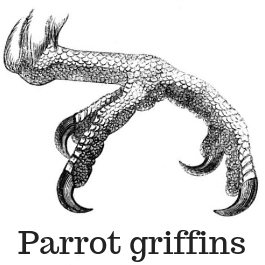
The forefoot of the pisitticogriff is like that of a parrot, rather than an eagle. Instead of having three forward facing toes with one rearward hook, as is common in raptors, the psitticogrif has two forward facing toes paired with two backward facing toes. This allows perching on branches, but it also permits the creature, if reports are to be believed, to grip cylindrical tools. There are no reports of the sort of fine motor skills necessary to write, only club-style gripping of cylindrical tools.
The second feature is that much as domestic cats, when warding predators, can stand for prolonged periods on their hind legs, so too can this sort of griffin. This leaves its forelimbs free to attack simultaneously, but it also leaves them free to manipulate tools. The rear half of the griffin is heavier than the bird half, and this imbalanced weight distribution also favours the rampant stance.
The rear half of the parrot griffin is not a lion, but a pard, a rare African creature of virtue known for its shimmering colours, and the tiny vibrant circles found all over its pelt. These pelt-patterns appear to be individually unique. Some psitticogrifs appear able to alter their colouration when hunting or fleeing, to more closeyt blend with their surroundings. Psitticogrifs have feline ears, but unlike a conventional griffin, its ears aren’t triangular: they are a curved on the outer edge. The ears are also difficult to spot because their edges are disguised by the shifting colours of the pelt.
Aquilogrifs are known to guard eggs made from agates in nests woven from gold. The psitticogrifs do not do this. It is claimed that their eggs are literally invisible until they hatch, after which they have an opalescent sheen. The parents tend them using Second Sight. The nests are of conventional materials. They often contain primitive spike traps to discourage predators: when thorns are not available, the psitticogriffs make these spikes themselves by gnawing sticks into wickedly sharp barbs..
Several houses are interested in the possibility of breeding these creatures. Their capacity for speech, potential for tool use, and symbolic tie to the art of Imaginem make them interesting as potential familiars, and as messengers for the redcaps.
Magic (Faerie?) Might: 15 (Animal)
Characteristics: Int -1, Per +3, Pre +2, Com 0, Str -2, Sta +1, Dex +2, Qik +6 Size:-1
Confidence: 1 (3 points)
Virtues and Flaws: Magical Monster; Ferocity (may use Confidence points only when flock threatened), Homing Instinct (always knows where flock is in relation to self), Keen Vision
Qualities and Inferiorities: Focus Power (Nests of Gold), Improved Abilities, Improved Attack x 2 (beak and claws), Improved Damage x 2 (beak and claws), Improved Soak x 2, Minor Virtue (Improved Characteristics), Minor Virtue (Long Winded), Minor Virtue (Puissant Athletics), Minor Virtue (Second Sight), Minor Virtue (Strong Willed).
Personality Traits: Defends flock +3, Sneaky +2
Combat*: Beak: Init +8, Attack +13, Defense +15, Damage +3
Grapple:** Init: +8, Attack +8, Defense +14, Damage: special (On subsequent
rounds may add Grapple Strength to Attack Roll for beak attacks.)
Claws: Init +8, Attack +14, Defense +13, Damage +4
* Psitticogrif flocks fight as trained units.
** The parrot beak of the psitticogrif does less piercing damage than the beak of an eagle, but is particularly suited to cracking open armor and sheering through limbs at the bones.
Soak: +7 (the skull of a parrot griffon is harder than steel)
Fatigue Levels: OK, 0, –1, –3, –5, Unconscious
Wound Penalties: –1 (1–4), –3 (5–8), –5 (9–12), Incapacitated (13-17), Dead (18+)
Abilities: Animal Handling 1 (griffons), Area Lore 4 (home territory), Area Lore 1 (gold rich territory), Athletics 5+2* (flight), Awareness 5 (prey), Brawl 5 (claws), Hunt 4 (horses), Second Sight 3 (Illusions), Survival 4 (home terrain). Some have Single Weapon or Thrown Weapon skills.
Soak: +7 (the skull of a parrot griffon is harder than steel)
Fatigue Levels: OK, 0, –1, –3, –5, Unconscious
Wound Penalties: –1 (1–4), –3 (5–8), –5 (9–12), Incapacitated (13-17), Dead (18+)
Abilities: Animal Handling 1 (griffons), Area Lore 4 (home territory), Area Lore 1 (gold rich territory), Athletics 5+2 (flight), Awareness 5 (prey), Brawl 5 (claws), Hunt 4 (horses), Second Sight 3 (Illusions), Survival 4 (home terrain). Most have a craft skill that allows rudimentary tool construction.
Powers:
Bemuse the eye and ear, 5 points, Init –1, Imaginem: A catch-all power that allows the creature to disguise itself, using Imaginem spells up to level 25, at the cost of 1 Might per magnitude. Most psitticogrifs only use Personal range, but some can use extended ranges. What this difference signifies is unknown, but is speculated to relate to nest tending behaviour.
Mimic: o points. A psitticogrif can naturally mimic a wide variety of sounds, and is capable of human speech.
Vis: 3 of Imaginem, feathers
Appearance: A psitticogrif is the size of a large dog, and its features
combine those of a pard and a parrot. The head, forequarters
and forelimbs of the griffon are avian, while the hind legs, torso
and tail are feline. Psitticogrifs are intelligent, colourful, swift and have a magical ability to change appearance. As they hunt in flocks, and are able to mould their environment using tools, they are dangerous despite their modest size.
 Games From Folktales
These are amazing! why have I never heard of them before?
LikeLike
They aren’t folkloric. A contributor to the Discord had found an image by a modern artist and asked what it would be like in Ars, so I worked them up.
The parrot folklore and pard folklore are real, and the domestic cat social structure is found in feral groups.
LikeLike