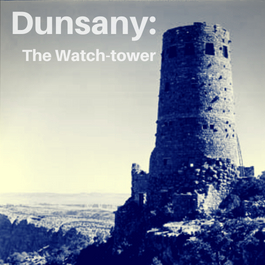
This short story by Lord Dunsany is a character study of a ghost. It demonstrates the tragedy of that type of undeath in Mythic Europe. Ghosts do not learn, and that means that sometimes their task cannot be completed. They linger on pointlessly: senselessly suffering.
Imagine your covenant has a similar sort of ghost. Should you keep him as a guard, or find a way to convince him to rest? If a rival covenant had a ghostly watcher like this, how could you lay it to rest at just the right time for maximum advantage?
The Watch-tower
I sat one April in Provence on a small hill above an ancient town that Goth and Vandal as yet have forborne to “bring up to date.”
On the hill was an old worn castle with a watch-tower, and a well with narrow steps and water in it still.
The watch-tower, staring South with neglected windows, faced a broad valley full of the pleasant twilight and the hum of evening things: it saw the fires of wanderers blink from the hills, beyond them the long forest black with pines, one star appearing, and darkness settling slowly down on Var.
Sitting there listening to the green frogs croaking, hearing far voices clearly but all transmuted by evening, watching the windows in the little town glimmering one by one, and seeing the gloaming dwindle solemnly into night, a great many things fell from mind that seem important by day, and evening in their place planted strange fancies.
Little winds had arisen and were whispering to and fro, it grew cold, and I was about to descend the hill, when I heard a voice behind me saying, “Beware, beware.”
So much the voice appeared a part of the evening that I did not turn round at first; it was like voices that one hears in sleep and thinks to be of one’s dream. And the word was monotonously repeated, in French.
When I turned round I saw an old man with a horn. He had a white beard marvellously long, and still went on saying slowly, “Beware, beware.” He had clearly just come from the tower by which he stood, though I had heard no footfall. Had a man come stealthily upon me at such an hour and in so lonesome a place I had certainly felt surprised; but I saw almost at once that he was a spirit, and he seemed with his uncouth horn and his long white beard and that noiseless step of his to be so native to that time and place that I spoke to him as one does to some fellow-traveller who asks you if you mind having the window up.
I asked him what there was to beware of.
“Of what should a town beware,” he said, “but the Saracens?”
“Saracens?” I said.
“Yes, Saracens, Saracens,” he answered and brandished his horn.
“And who are you?” I said.
“I, I am the spirit of the tower,” he said.
When I asked him how he came by so human an aspect and was so unlike the material tower beside him he told me that the lives of all the watchers who had ever held the horn in the tower there had gone to make the spirit of the tower. “It takes a hundred lives,” he said. “None hold the horn of late and men neglect the tower. When the walls are in ill repair the Saracens come: it was ever so.”
“The Saracens don’t come nowadays,” I said.
But he was gazing past me watching, and did not seem to heed me.
“They will run down those hills,” he said, pointing away to the South, “out of the woods about nightfall, and I shall blow my horn. The people will all come up from the town to the tower again; but the loopholes are in very ill repair.”
“We never hear of the Saracens now,” I said.
“Hear of the Saracens!” the old spirit said. “Hear of the Saracens! They slip one evening out of that forest, in the long white robes that they wear, and I blow my horn. That is the first that anyone ever hears of the Saracens.”
“I mean,” I said, “that they never come at all. They cannot come and men fear other things.” For I thought the old spirit might rest if he knew that the Saracens can never come again. But he said, “There is nothing in the world to fear but the Saracens. Nothing else matters. How can men fear other things?”
Then I explained, so that he might have rest, and told him how all Europe, and in particular France, had terrible engines of war, both on land and sea; and how the Saracens had not these terrible engines either on sea or land, and so could by no means cross the Mediterranean or escape destruction on shore even though they should come there. I alluded to the European railways that could move armies night and day faster than horses could gallop. And when as well as I could I had explained all, he answered, “In time all these things pass away and then there will still be the Saracens.”
And then I said, “There has not been a Saracen either in France or Spain for over four hundred years.”
And he said, “The Saracens! You do not know their cunning. That was ever the way of the Saracens. They do not come for a while, no not they, for a long while, and then one day they come.”
And peering southwards, but not seeing clearly because of the rising mist, he silently moved to his tower and up its broken steps.
Statistics
The watch-tower ghost is a spirit of place, rather than the ghost of a particular human. It is created by the labours of one hundred watchers.
 Games From Folktales
Stats to follow. RL drama.
LikeLike
The Guardian of the Watch-tower
With thanks to Matt Ryan, whose stats I’ve reskinned here. (English Knight – Tales of Mythic Europe).
Magic Might: 10
Characteristics: Int 0, Per +1, Pre –1, Com 0, Str +3, Sta +2, Dex +2, Qik -1
Size: 0
Age: appears 30, but was older when he died.
Virtues and Flaws: Magic Spirit, Affinity with Single Weapon, Improved Characteristics; Magical Monster, Dutybound.
Personality Traits: Distrusts the invaders +4, Defend the tower +3.
Powers: Donning the Corporeal Veil, 5 points, Init 0. Allows the ghost to take material form until it releases its materiality. The ghost’s
personal equipment also becomes material.
Combat:
Dodge: Init -1, Attack n/a, Defense +5, Damage n/a
Lance and shield (mounted): Init +1, Attack +17, Defense +14, Damage +8
Long sword and shield (mounted): Init +1, Attack +15, Defense +14, Damage +10.
Lance (dismounted): Init +2, Attack +8, Defense +4, Damage +10
Long sword and shield (dismounted): Init +1, Attack +12, Defense +11, Damage +10
Soak: +10 (but immune to mortal weapons)
Wound Penalties: –1 (1–5), –3 (6–10), –5 (11–15), Incapacitated (16–20), Dead (21+)
Abilities: Athletics 4 (armored), Area Lore: Tower 6 (surroundings), Brawl 5 (in armor), Arabic 2 (threats), Awareness 12 (tower area),
Etiquette 3 (outdated), French 1 (military commands), Castilian 5 (military commands), Great Weapon 2 (lance, dismounted), Hunt 3
(horseback), Intrigue 6 (when being plotted against), Leadership 3 (Castilians), Ride 3 (battle), Single Weapon 7 (lance).
Equipment: Charger, full chainmail, lance, cavalry sword, shield
Vis: 2 pawns, Mentem
Appearance: An armored knight of a past age. He is fixated on the idea that the invaders will return. Swap out language skills and
accoutrements to move him to a different borderland.
Ghostly Warder With Lost Heart
Magic Might: 10 (Mentem)
Characteristics: Int +1, Per +1, Pre +2, Com +1, Str +1, Sta 0, Dex 0, Qik 0
Size: -2 (child, non-physical)
Confidence Score: 1 (3)
Virtues and Flaws: Vary (May take Virtues and Flaws as a grog, if desired by the troupe.)
Personality Traits: Protective +3, Vengeful +3, Sad +1
Combat: Fingernails (claws): Init +0, Attack +6, Defense +6, Damage +3
Abilities: [Area] Lore 5 (site of death), Awareness 5 (where the protected is),
Brawl 5 claws, Infernal Lore 1 (sacrificial rituals), Folk Ken 4 (life experience), Living Language 5 (whispers), Profession 2 (as life).
Powers:
Donning the Corporeal Veil, 5 points, Init 0. Allows the ghost to take material form until it releases its materiality. The ghost’s
personal equipment also becomes material.
Kinesis, 5 points, Init 0, Terram: The ghost can move an object as if physically present. One expenditure of Might allows the ghost to
move one object until they put it down again.
Equipment: Clothing, stained by the extraction of the heart. A sentimental object.
Vis: Arguably 2 pawns, Mentem, but there’s special rule in ArM5 Core rulebook (p.193) that says none, because magi cannot render
other characters’ Ghostly Warders down for vis.
LikeLike