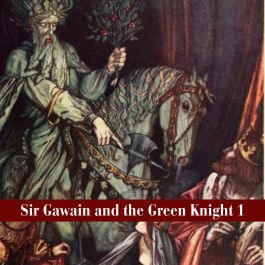
In our collection of potential mystery cults from Cheshire folklore, we have one potential mystagogue that I did not know was local. Sir Gawain and the Green Knight, one of the best known Arthurian stories, is set on the Wirral, a coastal area in the northwest of Cheshire. The name of the poet who wrote it is unknown, but his work includes local geographical markers such that scholars think he was likely local. Tracking these terms it’s possible to identify potential sites for the castle in which Gawain stays before his receipt of the Green Knight’s stroke, and the chapel where this occurs. The Green Chapel is a mystery site to which Gawain travels as an Ordeal.
The poem is written in four “fits”, an older English word for sections. Each of these will get an episode, and they will be followed by a fifth that considers the material added by one translator, Charlton Miner Lewis. Lewis didn’t like the plot of the original story, which ends with the revelation that the Green Knight was sent to Camelot by Morgana Le Fay in an attempt to frighten Guinevere to death. This plan fails utterly and doesn’t drive the Green Knight to play the temptation and trade games with Gawaine later. Lewis patches this by making the Green Knight a servant of the Queen of Faeries who is testing Gawaine to make sure he is suitable as a husband for a lady raised by the faeries that has fallen in love with him. This patch drags the story out of the obscure space that can be used to create a mystery cult, so I won’t use it for the primary run of episodes, but it does give us an NPC that might join a covenant.
We begin with a Librivox recording by Thomas Copeland. Thanks to him and his production team. I’ll break in as we go with commentary.
***
King Arthur lay at Camelot upon a Christmas-tide, with many a gallant lord and lovely lady, and all the noble brotherhood of the Round Table. There they held rich revels with gay talk and jest; one while they would ride forth to joust and tourney, and again back to the court to make carols; for there was the feast holden fifteen days with all the mirth that men could devise, song and glee, glorious to hear, in the daytime, and dancing at night.
Remember in the Middle Ages Christmas is a season, not a day. Fifteen days is longer than the 12 days usual later.
Halls and chambers were crowded with noble guests, the bravest of knights and the loveliest of ladies, and Arthur himself was the comeliest king that ever held a court. For all this fair folk were in their youth, the fairest and most fortunate under heaven, and the king himself of such fame that it were hard now to name so valiant a hero.
Now the New Year had but newly come in, and on that day a double portion was served on the high table to all the noble guests, and thither came the king with all his knights, when the service in the chapel had been sung to an end.
A “double portion” is an odd translation. The initial wording means that two people were sharing a single trencher, which was considered a sign of wealth, rather than that each person was eating twice as much as usual.
And they greeted each other for the New Year, and gave rich gifts, the one to the other (and they that received them were not wroth, that may ye well believe!), and the maidens laughed and made mirth till it was time to get them to meat. Then they washed and sat them down to the feast in fitting rank and order, and Guinevere the queen, gaily clad, sat on the high daïs. Silken was her seat, with a fair canopy over her head, of rich tapestries of Tars, embroidered, and studded with costly gems; fair she was to look upon, with her shining grey eyes, a fairer woman might no man boast himself of having seen.
“Tapestries of Tars” is a historical puzzle. We know that Tartarium was the name given to richly decorated cloth used by royalty. It appears in the accounts of Edward III. There is some debate if it comes from Tartary, travels trough Tartary from Tibet, is made in Tarsus, or comes from Tortona (which is near Milan.)
But Arthur would not eat till all were served, so full of joy and gladness was he, even as a child; he liked not either to lie long, or to sit long at meat, so worked upon him his young blood and his wild brain. And another custom he had also, that came of his nobility, that he would never eat upon an high day till he had been advised of some knightly deed, or some strange and marvellous tale, of his ancestors, or of arms, or of other ventures. Or till some stranger knight should seek of him leave to joust with one of the Round Table, that they might set their lives in jeopardy, one against another, as fortune might favour them. Such was the king’s custom when he sat in hall at each high feast with his noble knights, therefore on that New Year tide, he abode, fair of face, on the throne, and made much mirth withal.
Note that this was written when the real king was a young man, and these characteristics of Arthur’s aren’t necessarily considered virtues in a ruler. He has vigour, certainly, but men fighting to “set their lives at jeopardy” for his amusement wasn’t, even at the time, considered a worthwhile use of shed blood.
Thus the king sat before the high tables, and spake of many things; and there good Sir Gawain was seated by Guinevere the queen, and on her other side sat Agravain, à la dure main ; both were the king’s sister’s sons and full gallant knights.
Agravain is Gawain’s younger brother. He’s not a villain in this piece, but in others he’s proud to the point of wanting to kill his younger brother Gaheris. In later work Arthur has two sisters, Morgana and Maragwise, the later of which is married to King Lot of Orkney. These are the parents of Gawain. In earlier works, Like Layamon, Arthur has one sister, Anna, and Morgana isn’t a relative. Agravin’s French note there means “hard handed”, which is a sort of nickname.
And at the end of the table was Bishop Bawdewyn, and Ywain, King Urien’s son, sat at the other side alone.
Bawdwin is one a member of the necromantic underground in the Church. He’s a wizard, but not a powerful one.
Ywain is Morgana’s son, but he’s traditionally not on her team when it comes to scheming. He has a pet lion from another of his adventures. He’s based on a historical figure, Owain mab Urien, who ruled in the Cumbria and Galloway area. So, he’s another of Arthur’s nephews. Gawain, as the oldest son of the oldest sister is Arthur’s heir.
These were worthily served on the daïs, and at the lower tables sat many valiant knights. Then they bare the first course with the blast of trumpets and waving of banners, with the sound of drums and pipes, of song and lute, that many a heart was uplifted at the melody. Many were the dainties, and rare the meats, so great was the plenty they might scarce find room on the board to set on the dishes. Each helped himself as he liked best, and to each two were twelve dishes, with great plenty of beer and wine.
Again the note of dining in pairs. Meat being rare here is not qa comment on how deeply it is cooked. It means “exotic”.
Now I will say no more of the service, but that ye may know there was no lack, for there drew near a venture that the folk might well have left their labour to gaze upon. As the sound of the music ceased, and the first course had been fitly served, there came in at the hall door one terrible to behold, of stature greater than any on earth; from neck to loin so strong and thickly made, and with limbs so long and so great that he seemed even as a giant. And yet he was but a man, only the mightiest that might mount a steed; broad of chest and shoulders and slender of waist, and all his features of like fashion; but men marvelled much at his colour, for he rode even as a knight, yet was green all over.
Horses in Arthur’s time were a lot smaller than in the Middle Ages. There are a couple of knights who are so large they cannot ride because their feet drag, since horses are only pony-sized.
For he was clad all in green, with a straight coat, and a mantle above; all decked and lined with fur was the cloth and the hood that was thrown back from his locks and lay on his shoulders.
The green colour here is one of the most intricately contested symbols for people who write about this story. The handy thing for players is they can take whichever explanation they wish. Is he Jack in the Green, representing spring at the Winter solstice? Is he green because faeries are green? Is he green to show he’s an exception to natural laws?
One translator notes that the “hood” here might be the hood of a garment, but might also be a garment of mail that covers the back of the neck. The original word is, apparently, suitable for both interpretations. In that interpretation his “coat” above is a coat of mail, but later he is said to lake armor plates.
Hose had he of the same green, and spurs of bright gold with silken fastenings richly worked; and all his vesture was verily green. Around his waist and his saddle were bands with fair stones set upon silken work, ’twere too long to tell of all the trifles that were embroidered thereon—birds and insects in gay gauds of green and gold.
All the trappings of his steed were of metal of like enamel, even the stirrups that he stood in stained of the same, and stirrups and saddle-bow alike gleamed and shone with green stones. Even the steed on which he rode was of the same hue, a green horse, great and strong, and hard to hold, with broidered bridle, meet for the rider.
The knight was thus gaily dressed in green, his hair falling around his shoulders, on his breast hung a beard, as thick and green as a bush, and the beard and the hair of his head were clipped all round above his elbows. The lower part of his sleeves were fastened with clasps in the same wise as a king’s mantle. The horse’s mane was crisped and plaited with many a knot folded in with gold thread about the fair green, here a twist of the hair, here another of gold. The tail was twined in like manner, and both were bound about with a band of bright green set with many a precious stone; then they were tied aloft in a cunning knot, whereon rang many bells of burnished gold. Such a steed might no other ride, nor had such ever been looked upon in that hall ere that time; and all who saw that knight spake and said that a man might scarce abide his stroke.
The knight bore no helm nor hauberk, neither gorget nor breast-plate, neither shaft nor buckler to smite nor to shield, but in one hand he had a holly-bough, that is greenest when the groves are bare, and in his other an axe, huge and uncomely, a cruel weapon in fashion, if one would picture it. The head was an ell-yard long, the metal all of green steel and gold, the blade burnished bright, with a broad edge, as well shapen to shear as a sharp razor. The steel was set into a strong staff, all bound round with iron, even to the end, and engraved with green in cunning work. A lace was twined about it, that looped at the head, and all adown the handle it was clasped with tassels on buttons of bright green richly broidered.
Why is he carrying a holly branch? The poet says it is a symbol of peace, but I’ve not seen that connection anywhere else. Holly is green when everything else is dead, and the red of the berries is sometimes compared to Christ’s blood. The “lace” is a cord. Usually this was used as a wrist-strap so that if the weapon was knocked from the hand it didn’t drop to the ground. The tassels are an odd touch. Hard to keep clean, you’d imagine.
The knight halted in the entrance of the hall, looking to the high daïs, and greeted no man, but looked ever upwards; and the first words he spake were, “Where is the ruler of this folk? I would gladly look upon that hero, and have speech with him.” He cast his eyes on the knights, and mustered them up and down, striving ever to see who of them was of most renown.
This is an announcement for dramatic effect. The ruler is either the host at the high table or his most significant guest and seated at the host’s right hand.
Then was there great gazing to behold that chief, for each man marvelled what it might mean that a knight and his steed should have even such a hue as the green grass; and that seemed even greener than green enamel on bright gold.
To quickly explain here: some Venetians developed a process where enamel (fused glass powder) is backed by gold, which makes it more luminous because the underlayer is reflective.
All looked on him as he stood, and drew near unto him wondering greatly what he might be; for many marvels had they seen, but none such as this, and phantasm and faërie did the folk deem it. Therefore were the gallant knights slow to answer, and gazed astounded, and sat stone still in a deep silence through that goodly hall, as if a slumber were fallen upon them. I deem it was not all for doubt, but some for courtesy that they might give ear unto his errand.
Then Arthur beheld this adventure before his high daïs, and knightly he greeted him, for discourteous was he never. “Sir,” he said, “thou art welcome to this place—lord of this hall am I, and men call me Arthur. Light thee down, and tarry awhile, and what thy will is, that shall we learn after.”
Arthur offers him hospitality, and the knight declines it, so that violence is socially permissible.
“Nay,” quoth the stranger, “so help me He that sitteth on high, ’twas not mine errand to tarry any while in this dwelling; but the praise of this thy folk and thy city is lifted up on high, and thy warriors are holden for the best and the most valiant of those who ride mail-clad to the fight. The wisest and the worthiest of this world are they, and well proven in all knightly sports. And here, as I have heard tell, is fairest courtesy, therefore have I come hither as at this time. Ye may be sure by the branch that I bear here that I come in peace, seeking no strife. For had I willed to journey in warlike guise I have at home both hauberk and helm, shield and shining spear, and other weapons to mine hand, but since I seek no war my raiment is that of peace. But if thou be as bold as all men tell thou wilt freely grant me the boon I ask.”
And Arthur answered, “Sir Knight, if thou cravest battle here thou shalt not fail for lack of a foe.”
Here htere’s a breach in Arthur’s usual game of courtesy. Often people say “I ask for a boon!” and Arthur goes “Sure!” knowing full well that he can afford anything once he gets the magic rock that gives him a handful of gold each day. Giving people free wishes seems foolish right up until the point you remember that if you ask for the wrong boon, one of Arthur’s lads will knock you on the head and then go “Oh, woe is me for breaking the bonds of courtesy! I shall run mad in the forest for a year!” and people go “Oh, Lancelot. Always running mad in the forest…” You get a wish, but if you make one outside the bounds of propriety you don’t get to keep it. What’s proper varies by time and plac,e though: the king of Hungary in 1220 says that you know a a gift’s a good one when it is so great no-one can gague its worth, which makes him quite popular with his nobles, but also makes it tricky for his descendants to keep the nobility in check.
And the knight answered, “Nay, I ask no fight, in faith here on the benches are but beardless children, were I clad in armour on my steed there is no man here might match me. Therefore I ask in this court but a Christmas jest, for that it is Yule-tide, and New Year, and there are many here. If any one in this hall holds himself so hardy, so bold both of blood and brain, as to dare strike me one stroke for another, I will give him as a gift this axe, which is heavy enough, in sooth, to handle as he may list, and I will abide the first blow, unarmed as I sit. If any knight be so bold as to prove my words let him come swiftly to me here, and take this weapon, I quit claim to it, he may keep it as his own, and I will abide his stroke, firm on the floor.
Then shalt thou give me the right to deal him another, the respite of a year from to-day shall he have. Now pledge me thy word, and let see whether any here dare say aught.”
Now if the knights had been astounded at the first, yet stiller were they all, high and low, when they had heard his words. The knight on his steed straightened himself in the saddle, and rolled his eyes fiercely round the hall, red they gleamed under his green and bushy brows. He frowned and twisted his beard, waiting to see who should rise, and when none answered he cried aloud in mockery, “What, is this Arthur’s hall, and these the knights whose renown hath run through many realms? Where are now your pride and your conquests, your wrath, and anger, and mighty words? Now are the praise and the renown of the Round Table overthrown by one man’s speech, since all keep silence for dread ere ever they have seen a blow!”
With that he laughed so loudly that the blood rushed to the king’s fair face for very shame; he waxed wroth, as did all his knights, and sprang to his feet, and drew near to the stranger and said, “Now by heaven foolish is thine asking, and thy folly shall find its fitting answer. I know no man aghast at thy great words. Give me here thine axe and I shall grant thee the boon thou hast asked.” Lightly he sprang to him and caught at his hand, and the knight, fierce of aspect, lighted down from his charger.
Then Arthur took the axe and gripped the haft, and swung it round, ready to strike. And the knight stood before him, taller by the head than any in the hall; he stood, and stroked his beard, and drew down his coat, no more dismayed for the king’s threats than if one had brought him a drink of wine.
Then Gawain, who sat by the queen, leaned forward to the king and spake, “I beseech ye, my lord, let this venture be mine. Would ye but bid me rise from this seat, and stand by your side, so that my liege lady thought it not ill, then would I come to your counsel before this goodly court. For I think it not seemly that such challenge should be made in your hall that ye yourself should undertake it, while there are many bold knights who sit beside ye, none are there, methinks, of readier will under heaven, or more valiant in open field. I am the weakest, I wot, and the feeblest of wit, and it will be the less loss of my life if ye seek sooth. For save that ye are mine uncle naught is there in me to praise, no virtue is there in my body save your blood, and since this challenge is such folly that it beseems ye not to take it, and I have asked it from ye first, let it fall to me, and if I bear myself ungallantly then let all this court blame me.”
Then they all spake with one voice that the king should leave this venture and grant it to Gawain.
Gawain is not, generally, this model of modesty. Arthur aside, Gawain’s the main hero in early English Arthurian romances. Later Lancelot, a French import, comes in to take a lot ofthe work off of him, but the idea that he is a bear or little brain or brawn and the court will miss him least is laying it on a bit thicker than is strictly necessary. Note that he can’t leave the table without being asked to rise by his hostess, or his host.
Then Arthur commanded the knight to rise, and he rose up quickly and knelt down before the king, and caught hold of the weapon; and the king loosed his hold of it, and lifted up his hand, and gave him his blessing, and bade him be strong both of heart and hand. “Keep thee well, nephew,” quoth Arthur, “that thou give him but the one blow, and if thou redest him rightly I trow thou shalt well abide the stroke he may give thee after.”
Gawain stepped to the stranger, axe in hand, and he, never fearing, awaited his coming. Then the Green Knight spake to Sir Gawain, “Make we our covenant ere we go further. First, I ask thee, knight, what is thy name? Tell me truly, that I may know thee.”
“In faith,” quoth the good knight, “Gawain am I, who give thee this buffet, let what may come of it; and at this time twelvemonth will I take another at thine hand with whatsoever weapon thou wilt, and none other.”
Then the other answered again, “Sir Gawain, so may I thrive as I am fain to take this buffet at thine hand,” and he quoth further, “Sir Gawain, it liketh me well that I shall take at thy fist that which I have asked here, and thou hast readily and truly rehearsed all the covenant that I asked of the king, save that thou shalt swear me, by thy troth, to seek me thyself wherever thou hopest that I may be found, and win thee such reward as thou dealest me to-day, before this folk.”
“Where shall I seek thee?” quoth Gawain. “Where is thy place? By Him that made me, I wot never where thou dwellest, nor know I thee, knight, thy court, nor thy name. But teach me truly all that pertaineth thereto, and tell me thy name, and I shall use all my wit to win my way thither, and that I swear thee for sooth, and by my sure troth.”
“That is enough in the New Year, it needs no more,” quoth the Green Knight to the gallant Gawain, “if I tell thee truly when I have taken the blow, and thou hast smitten me; then will I teach thee of my house and home, and mine own name, then mayest thou ask thy road and keep covenant. And if I waste no words then farest thou the better, for thou canst dwell in thy land, and seek no further. But take now thy toll, and let see how thy strikest.”
“Gladly will I,” quoth Gawain, handling his axe.
Then the Green Knight swiftly made him ready, he bowed down his head, and laid his long locks on the crown that his bare neck might be seen. Gawain gripped his axe and raised it on high, the left foot he set forward on the floor, and let the blow fall lightly on the bare neck. The sharp edge of the blade sundered the bones, smote through the neck, and clave it in two, so that the edge of the steel bit on the ground, and the head rolled even to the horse’s feet.
The blood spurted forth, and glistened on the green raiment, but the knight neither faltered nor fell; he started forward with out-stretched hand, and caught the head, and lifted it up; then he turned to his steed, and took hold of the bridle, set his foot in the stirrup, and mounted. His head he held by the hair, in his hand. Then he seated himself in his saddle as if naught ailed him, and he were not headless. He turned his steed about, the grim corpse bleeding freely the while, and they who looked upon him doubted them much for the covenant.
For he held up the head in his hand, and turned the face towards them that sat on the high daïs, and it lifted up the eye-lids and looked upon them, and spake as ye shall hear. “Look, Gawain, that thou art ready to go as thou hast promised, and seek leally till thou find me, even as thou hast sworn in this hall in the hearing of these knights. Come thou, I charge thee, to the Green Chapel, such a stroke as thou hast dealt thou hast deserved, and it shall be promptly paid thee on New Year’s morn. Many men know me as the knight of the Green Chapel, and if thou askest thou shalt not fail to find me. Therefore it behoves thee to come, or to yield thee as recreant.”
The Green Chapel is in Cheshire, which makes this relevant to our recent string of episodes on folklore from that part of England.
With that he turned his bridle, and galloped out at the hall door, his head in his hands, so that the sparks flew from beneath his horse’s hoofs. Whither he went none knew, no more than they wist whence he had come; and the king and Gawain they gazed and laughed, for in sooth this had proved a greater marvel than any they had known aforetime.
Note that he doesn’t put his head back on, as is something of a tradition in later stories.
Though Arthur the king was astonished at his heart, yet he let no sign of it be seen, but spake in courteous wise to the fair queen: “Dear lady, be not dismayed, such craft is well suited to Christmas-tide when we seek jesting, laughter and song, and fair carols of knights and ladies. But now I may well get me to meat, for I have seen a marvel I may not forget.” Then he looked on Sir Gawain, and said gaily, “Now, fair nephew, hang up thine axe, since it has hewn enough,” and they hung it on the dossal above the daïs, where all men might look on it for a marvel, and by its true token tell of the wonder.
A dossal is a piece that comes up from the back of an altar apparently. I thought it was the altar cloth, but I don’t see how “hung it on” works witrh that interpretation. We know Gwenivere has a seat that’s roofed by fabric, so perhaps there’s a superstructure above all of their seats.
Then the twain sat them down together, the king and the good knight, and men served them with a double portion, as was the share of the noblest, with all manner of meat and of minstrelsy. And they spent that day in gladness, but Sir Gawain must well bethink him of the heavy venture to which he had set his hand.
And on that cliffhanger we will wait for a month.
 Games From Folktales