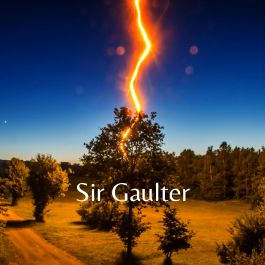
Our second ghostly visitant from Lanacastrian Ballads: this is a pair of ghosts, of which the unnamed lady is the more interesting. She’s linked to a lightning tree, which are sometimes sought out by magi as useful for enchantment. She may have powers related to the weather or may be strangely transformed into a dryad, sparking Original research.
As a note on names, the “Gu” formation changes over time into a “w”, so variants of this story call him by the more modern “Walter”.
Note that yew trees are associated with death in many parts of England. A supply of them was desired to make longbows, but their leaves are poisonous to sheep. In many areas people chose to grow yews in graveyards, because the walls protecting graves from defilement with animal manure also saved livestock from harm. Getting killed under a yew might have necromantic significance.
Thanks to Phil Benson and his Librivox production team. Stats when Mythic Europe Magazine is done.
***
Sir Gualter
At Northen, near Manchester, there was, till very recently, an ancient ferry across the river Mersey from Lancashire to Cheshire, called ” Northen Boat ;” the village of Northen, or Northenden, being in the latter county :
” Now ferry me o’er, thou good boatman !
I prithee, ferry me o’er !
That I may see my lady to-night,
Or I never may see her more.”
” The winds blow high, and the stream runs strong,
And I dare not ferry thee o’er ;
Thou canst not see thy lady to-night,
If thou never dost see her more.”
” I will see her to-night if my life be spared,
For I’ve heard the death-owl’s scream ;
Who has heard it once may not hear it twice,
She must hear my awful dream.”
” My boat is moor’d, and I will not cross ;
Sir Knight, thou may’st away ;
Or rest thee to-night till the morning’s light,
We will o’er at break of day.”
” Here’s gold in store, and thou shalt have more,
To venture across with me ;
If we die ere we reach the other bank,
A mass shall be said for thee.”
The boat is unmoor’d, and they both leap in,
And steer for the other side ;
Now swim thou swiftly, thou fearless boat,
Against the rushing tide.
Now, now for thy life, thou boatman, push,
For the stream runs swifter on ;
Another boat’s length, with all thy strength,
And the bank ye have safely won.
Tis past, ’tis past, they have reach’d the side,
And they both leap on the bank :
‘Tis well ! ’tis well ! with an eddying whirl
That boat hath swiftly sank.
Sir Gualter hath given the boatman gold,
Thence hastes to the trysting-tree ;
What a rueful sight for a gallant knight
Was there for him to see !
The Lady Isabel blacken’d and scorch’d
By the lightning blast of heaven ;
And that stately tree, where they oft had met,
Was leafless, and blasted, and riven !
He kneel’d him down o’er that lifeless form ;
And the death-owl o’er him flew,
And it scream’d as it pass’d on the rushing blast
Then his fate Sir Gualter knew.
Then he gather’d that form within his arms,
And rush’d to the river’s side ;
Then plunged from the bank, and both of them sank
In the darkly rolling tide.
There is a tradition in the neighbourhood that the spirits of the knight and the lady are still occasionally to be seen at midnight, especially in storms, beneath the aged yew, as if still bent on keeping their tryst, — love stronger than death itself!
 Games From Folktales