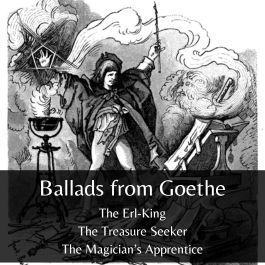
This is the second episode of poems from Goethe. Two of these will get stats eventually, and the middle is what happens when you fumble while selling your soul.
Alan Mapstone pronounces “Erl king” in a way that I’m forced to admit is correct, but sounds strange to my ear. The word he’s saying is the ancestor of the modern words “earl” and “jarl” which is why the leading vowel sounds like its partway between the modern vowels.
The word traditionally was read as meaning “elf king” but Goethe, personally, is where an altered reading enters folklore. He’s the source of the idea that it refers to the black alder tree. His poem has a precise location. It’s from the Saale Valley in the Rhine Tribunal.
The Erl-King
Who rides so late through the grisly night?
‘Tis a father and child, and he grasps him tight
He wraps him close in his mantle’s fold,
And shelters the boy from the piercing cold.
” My son, why thus to my arm dost cling?”
” Father, dost thou not see the Erle-king ?
The king with his crown and his long black train ! “
” My son, ’tis a streak of the misty rain ! “
” Come hither, thou darling ! come, go with me
Fine games know I that I’ll play with thee
Flowers many and bright do my kingdoms hold,
My mother has many a robe of gold.
” Oh father, dear father ! and dost thou not hear
What the Erlie-king whispers so low in mine ear 1 “
” Calm, calm thee, my boy, it is only the breeze,
As it rustles the wither’d leaves under the trees ! “
” Wilt thou go, bonny boy ! wilt thou go with me “?
My daughters shall wait on thee daintilie
My daughters around thee in dance shall sweep,
And rock thee, and kiss thee, and sing thee to sleep ! “
” O father, dear father ! and dost thou not mark
Erlie-king’s daughters move by in the dark ?
” I see it, my child ; but it is not they,
‘Tis the old willow nodding its head so grey ! “
” I love thee ! thy beauty, it charms me so ;
And I’ll take thee by force, if thou wilt not go ! “
” O father, dear father ! he’s grasping me
My heart is as cold as cold can be ! “
The father rides swiftly—with terror he gasps
The sobbing child in his arms he clasps ;
He reaches the castle with spurring and dread ;
But, alack ! in his arms the child lay dead !
What happens if you fumble selling your soul? Here’s the answer from Goethe.
The Treasure Seeker
I.
Many weary days I suffer’d,
Sick of heart and poor of purse
Riches are the greatest blessing
Poverty the deepest curse
Till at last to dig a treasure
Forth I went into the wood
” Fiend ! my soul is thine for ever ! “
And I sign’d the scroll with blood.
II.
Then I drew the magic circles,
Kindled the mysterious fire,
Placed the herbs and bones in order,
Spoke the incantation dire.
And I sought the buried metal
With a spell of mickle might
Sought it as my master taught me
Black and stormy was the night.
III.
And I saw a light appearing
In the distance, like a star
When the midnight hour was tolling,
Came it waxing from afar
Came it flashing, swift and sudden,
As if fiery wine it were,
Flowing from an open chalice.
Which a beauteous boy did bear.
IV.
And he wore a lustrous chaplet.
And his eyes were full of thought,
As he stepp’d into the circle
With the radiance that he brought.
And he bade me taste the goblet
And I thought—” It cannot be.
That this boy should be the bearer
Of the Demon’s gifts to me ! “
V.
” Taste the draught of pure existence
sparkling in this golden urn,
And no more with baleful magic
Shalt thou hitherward return.
Do not seek for treasures longer
Let thy future spellwords be,
Days of labour, nights of resting
So shall peace return to thee
The Magician’s Apprentice
This is the poem that was reworked by Disney as “Fantasia”. The spirit of the broom needs statistics eventually. The story is ultimately descended from The Lover of Lies by Lucian, where the sorcerer is a priest of Isis. This earlier version might suit Ars Magica better. I’ll quickly add it here: as it is only a couple of paragraphs long. This is from the Fowler and Fowler translation.
‘When I was a young man, I passed some time in Egypt, my father having sent me to that country for my education. I took it into my head to sail up the Nile to Coptus, and thence pay a visit to the statue of Memnon, and hear the curious sound that proceeds from it at sunrise. In this respect, I was more fortunate than most people, who hear nothing but an indistinct voice: Memnon actually opened his lips, and delivered me an oracle in seven hexameters; it is foreign to my present purpose, or I would quote you the very lines.
Well now, one of my fellow passengers on the way up was a scribe of Memphis, an extraordinarily able man, versed in all the lore of the Egyptians. He was said to have passed twenty-three years of his life underground in the tombs, studying occult sciences under the instruction of Isis herself.
‘You must mean the divine Pancrates, my teacher,’ exclaimed Arignotus; ‘tall, clean-shaven, snub-nosed, protruding lips, rather thin in the legs; dresses entirely in linen, has a thoughtful expression, and speaks Greek with a slight accent?’
‘Yes, it was Pancrates himself. I knew nothing about him at first, but whenever we anchored I used to see him doing the most marvellous things,—for instance, he would actually ride on the crocodiles’ backs, and swim about among the brutes, and they would fawn upon him and wag their tails; and then I realized that he was no common man. I made some advances, and by imperceptible degrees came to be on quite a friendly footing with him, and was admitted to a share in his mysterious arts. The end of it was, that he prevailed on me to leave all my servants behind at Memphis, and accompany him alone; assuring me that we should not want for attendance. This plan we accordingly followed from that time onwards.
Whenever we came to an inn, he used to take up the bar of the door, or a broom, or perhaps a pestle, dress it up in clothes, and utter a certain incantation; whereupon the thing would begin to walk about, so that every one took it for a man. It would go off and draw water, buy and cook provisions, and make itself generally useful. When we had no further occasion for its services, there was another incantation, after which the broom was a broom once more, or the pestle a pestle. I could never get him to teach me this incantation, though it was not for want of trying; open as he was about everything else, he guarded this one secret jealously. At last one day I hid in a dark corner, and overheard the magic syllables; they were three in number. The Egyptian gave the pestle its instructions, and then went off to the market.
Well, next day he was again busy in the market: so I took the pestle, dressed it, pronounced the three syllables exactly as he had done, and ordered it to become a water-carrier. It brought me the pitcher full; and then I said: “Stop: be water-carrier no longer, but pestle as heretofore.” But the thing would take no notice of me: it went on drawing water the whole time, until at last the house was full of it. This was awkward: if Pancrates came back, he would be angry, I thought (and so indeed it turned out). I took an axe, and cut the pestle in two. The result was that both halves took pitchers and fetched water; I had two water-carriers instead of one. This was still going on, when Pancrates appeared. He saw how things stood, and turned the water-carriers back into wood; and then he withdrew himself from me, and went away, whither I knew not.’
Now, back to Goethe.
Huzzah, huzzah ! His back is fairly
Turned about, the wizard old
And I’ll now his spirits rarely
To my will and pleasure mould
His spells and orgies—ha’n’t I
Marked them all aright
And I’ll do wonders, sha’n’t I
And deeds of mickle might.
Hear ye ! hear ye
Hence ! your spritely
Office rightly,
Featly showing
Toil, until with water clear, ye
Fill the bath to overflowing
Ho, thou battered broomstick ! take ye
This old seedy coat and wear it
Ha, thou household drudge ! I’ll make ye
Do my bidding ; ay, and fear it.
Don of legs a pair, now
A head too, for the nonce
To the river there, now
Bear the pail at once
Hear ye ! hear ye
Hence ! your spritely
Office rightly,
Featly showing
Toil, until with water clear, ye
Fill the bath to overflowing.
See, ’tis off—’tis at the river
In the stream the bucket flashes
Now ’tis back—and down, or ever
You can wink, the burden dashes.
Again, again, and quicker
The floor is in a swim.
And every stoup and bicker
Is running o’er the brim.
Stop, now stop
You have granted
All I wanted.
Stop! Oh rot it!
Running still ? I’m like to drop
What’s the word ? I’ve clean forgot it
Oh, the word, so strong and baleful,
To make it what it was before
There it skips with pail on pailful
Would thou wert a broom once more
Still new streams he scatters,
Found and ever round me
Oh, a hundred waters,
Rushing in, confound me
No—^no longer,
Can I brook it
I’ll rebuke it
Vile abortion
Woe is me, my fears grow stronger.
What grimacing, what contortion
Wilt thou, offspring of the devil,
Drench the house in hellish funning ?
Even now, above the level
Of the door, the water’s running.
Stop, wretch ! Won’t you hear me !
Only you come near me
Stop, broom, stop, I say !
Stop, I tell you,
I’ll not bear it.
No, I swear it
Let me catch you.
And upon the spot I’ll fell you
With my hatchet, and despatch you.
Back it comes—^will nought prevent it *?
If I only tackle to thee.
Soon, O Kobold ! thou’lt repent it,
When the steel goes crashing thro’ thee.
Bravely struck, and surely
There it goes in twain
Now I move securely.
And I breathe again
Woe and wonder
As it parted,
Straight up started,
‘Quipped aright.
Goblins twain that rush asunder.
Help, O help, ye powers of might
Deep and deeper grows the water
On the stairs and in the hall,
Rushing in with roar and clatter
Lord and master, hear me call
Ah, here comes the master
Sore, sir, is my strait
I raised this spirit faster
Far than I can lay’t.
” Broom, avaunt thee
To thy nook there
Lie, thou spook, there
Only answer,
When for mine own ends I want thee,
I, the master necromancer ! “
 Games From Folktales
The Erl-king
Faerie Might: 40+10 (Herbam)
Characteristics: Int +2, Per 0, Pre +2, Com +3, Str +4, Sta +2, Dex +4, Qik +1
Size: 0
Virtues and Flaws: 2 x Greater Faerie Powers, Highly Cognizant, Faerie Sight, Faerie Speech, 2 x Focus Power, 2 x Great Characteristic, Human Form, 6 x Improved Characteristics, 7 x Increased Faerie Might, 3 x Personal Faerie Powers, Place of Power (kingdom); Traditional Ward (The Erl-king cannot leave the forest, except by staying on a road that leads to the forest, with no crossroads or bridges over flowing water.) Slow Power (His powers have to be used in a precise sequence, so he is unable to use his killing powers immediately.)
Personality Traits: Wrathful when vexed +2
Combat:
Brawl (gauntlet)*: Init +1, Attack +11, Defense +9, Damage +6
Sabre**: Init +3, Attack +15, Defense +9, Damage +10
* Includes specialization.
** Includes specialization. Remember than a faerie’s accoutrements are part of their body, so the erl-king can use his Touch that kills power via sword strike, but is still prevented from harming those who have not refused him.
Soak: +2, sumptuous clothes.
Wound Penalties: –1 (1-5), –3 (6-10), –5 (11- 15), Incapacitated (16-20), Dead (21+)
Pretenses: (Area) Lore 6 (alder forest), Artes Liberales 3 (history), Awareness 6 (ambushes), Bargain 3 (travelers), Brawl 6 (gauntlet), Carouse 6 (feasting), Charm 6 (travelers), Concentration 3 (while hunting), Etiquette 3 (in court), Faerie Speech 6, Finesse 6 (Rego), Folk Ken 2 (customs of surrounding area), Guile 3 (travelers), Leadership 6 (when hunting travelers), Order of Hermes Lore 2 (Merinita), Penetration 6 (using Arcane Connections). Single Weapon 6 (sabre)
Powers:
Extended Glamor: 0 points, constant. The alder forest, but not, and this is odd enough that a magus might want to investigate it, the roads through that forest. His extended glamour is cut into large pieces and it annoys him, but causes him no harm.
Focus Power (Wood within his forest): up to 10 points, Init –9, Herbam. Note that in character creation, the same focus power has been selected twice to gain this higher level.
Hound: 0 points, Init –2, Corpus Allows the faerie to know the direction and distance to its human quarry. Note the longer duration than usual. As the Erl-king does not need to concentrate to use Hound he can maintain his awareness of all humans on the roads within his forest. Costs 25 spell levels (InCo Base 3, +4 Arc, +1 Sun, 3 intricacy points.)
Perpetually Present: 0 points, constant, Corpus. The king remains close to the victim: close enough to speak audibly. For the sake of appearances he may manifest a horse. If somehow left behind, he appears as a misty shape in the trees. This has been priced as per the power Flight and shares its limitations. The erl-king may not engage in combat while moving swiftly with this power.
(35 spell levels. ReCo Base 4, +2 Sun, +1 constant. This base is deliberately lower than Hermetic magic might suggest. 2 intracy points.)
Spirit Away: variable points, Init +1, Variable. A power used to move people into the faerie realm. The erl-king can only target those who have expressed a desire to join him. Full details on Realms of Power: Faerie page 23.
Touch that kills: 4 points, Init -3. When vexed by a person who will not follow him voluntarily, the Erl-king can kill with a touch. The erl-king can kill if rebuffed once, or if his offers are ignored three times.
(35 spell levels: PeCo30 is the minimum level for fatal effects. +5 Touch. In the erl-king’s build there are unspent intricacy points, but I don’t want to make this too cheap.)
Equipment: A small kingdom of faerie servants. Mystical artifacts which at a minimum include a scrying pool (see ArM5 page 122 for a spell that simulates this device). Centuries of shipwreck treasure. Clothed in white wool, with flowers in her long hair. Often carries a comb and mirror.
Vis: 8 pawns Rego, a comb, +2 if in kingdom
Appearance: A beautiful woman with long hair and fiery eyes, in a robe of the finest wool
Source: Based on the White Lady in Realms of Power: Faerie page 82-3.
LikeLike