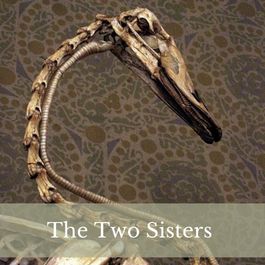
Although it is disguised a little with variants, the creature called Eala in the Magonomia Bestiary is the haunted harp found in one of the most popular folksongs of the British Isles. To keep things English, which was the remit of the book, I deliberately used a variant from Berwickshire, but we can look at the others for potential inspirations. Several of the versions take place in London.
The Twa Sisters is recorded in the Child Ballads, which aren’t nursery rhymes: they were collected by a folklorist named Francis Child. As a sign of its antiquity, it’s the tenth ballad recorded, in his five volume work. Textually he can trace it as far back as 1656, to a broadsheet called Wit Restor’d by a comedic author called James Smith, but the story appears so widely that it seems likely he did not pen it, but instead adapted something already known. Child himself finds it in the four nations of Britain, and in Poland, Estonia, Norway, Iceland, Denmark, Sweden and Germany. More recent researc hahs turned up variants as distant as Hungary.
There’s some variation in the stories, and this is why when someone tries to glue parts together, they have continuity errors. My favourite version of this song is “The Bonny Swans” by Loreena McKennitt, but you’ll notice that in her first verse there are three daughters of a farmer, and in the third verse there are two daughters of a king. In some versions the younger daughter offers to give up her lover, in others she refuses. In some she is drowned in the sea, or a river. In some they go to the water to wash, do laundry or look out for their father’s ship. You can twist this story very heavily to to suit your PCs and stay within the folkloristic tradition.
The drowned girl’s body, or part of her body, are almost always used to make an instrument. A viol is popular in some versions, and a harp in others. I used the viol because it’s something players will have less experience with, and because my daughter plays a vague relative of the viol. The part used varies substantially. It can be as little as her hair used for strings, but it eventually becomes a lengthy list. In some versions her trunk, skull, limbs, nose, hair. teeth, veins and fingers are used. One Swedish version has her body wash ashore, grow into a linden, and have a harper make an instrument from that.
Usually the instrument is taken to a wedding feast and breaks things up. The English versions of the song, in Child’s time, were so degraded that instead the harp is taken to the king. In McKennit’s version that’s why the girl seems to change families midstory. In some versions the instrument sounds without human aid, in some it compels a musician to play it, in others it just takes its chance when another tune is begun.
In the Icelandic versions, the song of the instrument is, of itself, fatal.
The first string made response: ‘The bride was my sister once.’
The bride on the bench, she spake: ‘The harp much trouble doth make.’
The second string answered the other: ‘She is parting me and my lover.’
Answered the bride, red as gore: ‘The harp is vexing us sore.’
The canny third string replied: ‘I owe my death to the bride.’
He made all the harp-strings clang; The bride’s heart burst with the pang.
The murderess is often burned. In one variant she is stabbed by the bridegroom. In a third she is banished after her sister is restored to life and pleads on her behalf. The younger sister rarely comes back to life: one variant has the harper smash his instrument after receiving a bribe from the bride. This disenchants the girl, who then has her sister sent into exile. It might serve as a guide to the NPC in Magonomia. Smashing the harp may be all she needs.
Here’s version A. Compare it with McKennitt, link above, to see how far it travels.
There were two sisters, they went playing,
With a hie downe downe a downe-a
To see their father’s ships come sayling in.
With a hy downe downe a downe-a
And when they came unto the sea-brym,
The elder did push the younger in.
O sister, O sister, take me by the gowne,
And drawe me up upon the dry ground.’
O sister, O sister, that may not bee,
Till salt and oatmeale grow both of a tree.’
Somtymes she sanke,
somtymes she swam,
Until she came unto the mill-dam.
The miller runne hastily downe the cliffe,
And up he betook her withouten her life.
What did he doe with her brest-bone?
He made him a violl to play thereupon.
What did he doe with her fingers so small?
He made him peggs to his violl withall.
What did he doe with her nose-ridge?
Unto his violl he made him a bridge.
What did he doe with her veynes so blew?
He made him strings to his violl thereto.
What did he doe with her eyes so bright?
Upon his violl he played at first sight.
What did he doe with her tongue so rough?
Unto the violl it spake enough.
What did he doe with her two shinnes?
Unto the violl they danc’d Moll Syms.
Then bespake the treble string,
‘O yonder is my father the king.’
Then bespake the second string,
‘O yonder sitts my mother the queen.’
And then bespake the strings all three,
‘O yonder is my sister that drowned mee.’
Now pay the miller for his payne,
And let him bee gone in the divel’s name.’
 Games From Folktales