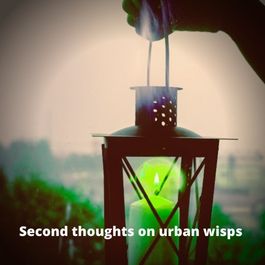
This is a short piece, compared to some of the others for the Bestiary series. My goals for the wisps were straightforward, so I got there without a lot of surplus material. When I wrote the urban wisps for the Magonomia Bestiary I wanted to introduce the Royal Exchange and suggest that the creatures were the source of the Gruen transfer, which blights shoppers in malls to this day. The Gruen transfer is a psychological trick, a sort of confusion or trance-like state, which is an involuntary response to deliberately-included architectural features. In the real world it causes people to wander about and impulse buy.
I first knew I’d missed a trick on urban wisps when I was listening to a quatrain by Madison Cawein. Cawein was an author from Kentucky whose work was in the same sort of vein as Shelley and Keats. He wrote around the turn of the Twentieth Century, and has some right to claim T S Eliot bit him for the idea of The Waste Land. There are several pieces which might be useful for games like Ars Magica and Magonomia, because he likes playing with the idea that there are forces behind natural features.
Before you go wading in, a quick note: with Cawein you’ll be zipping through his pastorals and stealing monsters when suddenly there’s a poem about the laws and methods of the Ku Klux Klan. Some people have tried to defend his views on race because he doesn’t actually say that the “we” in the poem includes himself, but…it’s a sudden shock to go from one tone to another. There are a couple of other works which pretty clearly put him over on the cross-burning side of society. That being said, he’s been dead for a hundred years and no-one is going to profit financially from these quotations.
Moths and Fireflies
Since Fancy taught me in her school of spells
I know her tricks—These are not moths at all,
Nor fireflies; but masking Elfland belles
Whose link-boys torch them to Titania’s ball.
A linkboy is a child who is paid to escort a pedestrian at night, and provide illumination. Sometimes they lead the person to where they can find a sedan chair instead, and then follow them from the chair’s end point to their house. The “link” in the name is a sort of cotton which is used in their torches. The term appears in Shakespeare so we know it’s in period for Magonomia. Falstaff says to Bardolph “Thou hast saved me a thousand marks in links and torches, walking with thee in the night betwixt tavern and tavern”, because Bardolph’s face is constantly red from alcoholism. A mark is two thirds of a pound, so that’s serious money.
Using linkboys was sometimes dangerous, because you could be led astray, into ambushes with footpads in dark alleys. This, to me, seemed a perfect way to envision urban wisps, leading people into danger. Some people had personal linkboys to prevent this occurring, but the position was considered low and menial. This may be where the expression “can’t hold a candle to X” comes from: the described thing is even to be a linkboy for X.
I was reading a lot about John Stow at the time. It seemed to me that having a friendly urban wisp essentially meant you had a safe linkboy, who could guide you about the streets. If I’d thought of it in time, I’d have made the Wisp Extra have the power to always lead their character home, which is useful for the lost and inebriated. It also seems like a good marker for my theoretical order of urban magicians based on Stow’s work: they all carry lamps with surprisingly active flames.
Cawein has another couple of poems about wisps which give us variants on what they think and do. In Fen-fire he posits a spirit that loves as it destroys.
The misty rain makes dim my face,
The night’s black cloak is o’er me;
I tread the dripping cypress-place,
A flickering light before me.
Out of the death of leaves that rot
And ooze and weedy water,
My form was breathed to haunt this spot,
Death’s immaterial daughter.
The owl that whoops upon the yew,
The snake that lairs within it,
Have seen my wild face flashing blue
For one fantastic minute.
But should you follow where my eyes
Like some pale lamp decoy you,
Beware! lest suddenly I rise
With love that shall destroy you.
Again in Mill-Water he has wisps as sprites who are doing something sneaky and idyllic, until you see beneath the superficial.
The water-flag and wild cane grow
‘Round banks whereon the sunbeams sow
Fantastic gold when, on its shores,
The wind sighs through the sycamores.
In one green angle, just in reach,
Between a willow-tree and beech,
Moss-grown and leaky lies a boat
The thick-grown lilies keep afloat.
And through its waters, half awake,
Slow swims the spotted water-snake;
And near its edge, like some gray streak,
Stands gaunt the still fly-up-the-creek.
Between the lily-pads and blooms
The water-spirits set their looms,
That weave the lace-like light that dims
The glimmering leaves of under limbs.
Each lily is the hiding-place
Of some dim wood-imp’s elvish face,
That watches you with gold-green eyes
Where bubbles of its breathing rise.
I fancy, when the waxing moon
Leans through the trees and dreams of June,
And when the black bat slants its wing,
And lonelier the green-frogs sing;
I fancy, when the whippoorwill
In some old tree sings wild and shrill,
With glow-worm eyes that dot the dark,
Each holding high a firefly spark
To torch its way, the wood-imps come:
And some float rocking here; and some
Unmoor the lily leaves and oar
Around the old boat by the shore.
They climb through oozy weeds and moss;
They swarm its rotting sides and toss
Their firefly torches o’er its edge
Or hang them in the tangled sedge.
The boat is loosed. The moon is pale.
Around the dam they slowly sail.
Upon the bow, to pilot it,
A jack-o’-lantern gleam doth sit.
Yes, I have seen it in my dreams!
Naught is forgotten! naught, it seems!
The strangled face, the tangled hair
Of the drown’d woman trailing there.
 Games From Folktales