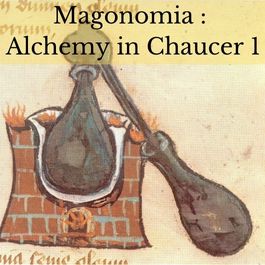
One of the most popular books in Elizabethan England is The Canterbury Tales by Geoffrey Chaucer. It’s essentially a 14th Century anthology with a frame narrative, where a group of pilgrims amuse each other by telling stories. Late in the series we get the tale we will examine today, where a priest’s servant (a canon’s yeoman) explains how he and his master attempt to create gold alchemically, how the science of alchemy is addictive, and how they are driven to poverty and fraud to pursue it. He also gives the story of a more successful confidence trick by someone in the same profession, but that will wait for next month’s episode
By the 16th Century, people interested in the subtle science had become convinced that Chaucer was one of its masters. What he writes in this story is enough to demonstrate that he knows some of the basic processes, and that he has been trained in the obfuscating language used by alchemists to describe the Great Work. He is also known to have written a partial treatise on the construction and use of an astrolabe. It was written for a child, so it is in plain, contemporary English. His role of comptroller of the port of London gave him all kinds of opportunities to hide the wealth created by the art, and to arrange the importation of needed tools and reagents.
His family is, from an English perspective, effectively extinct. His daughter married into the de la Pole family, and his grandsons were some of the final claimants of the Yorkist line of Plantagenets. He has a few descendants whose ancestors escaped to France during the Tudor ascension, and married well there. There is not, however, any known practitioner who carries on his magical work in the Reign.
There was no trace of a laboratory in his London residences, but a cache of his materials may exist somewhere. Biographical research indicates that he became a deputy forester for the king toward the end of his life, and had a remote hunting lodge under his care. This might have proven a suitable site for a laboratory.
Our reader is Joshua Young from Librivox, but the version he’s recorded removes the yeoman’s prologue. Essentially, the dialogue is as follows. When the prilgrims take to the road after staying at an inn for the night, two more people hurry up, and ask to join their company. The host, the leader of the pilgrims, asks who they are, and the yeoman says his master is a wonderfully wise man. The host says he’s welcome if he can tell a merry tale or two. The yeoman answers that his lord has done many interesting things, and so will have tales to tell. The host then asks if he is a clerk, and the yeoman says he’s better than that: he’s a canon and that he’s so clever he could pave the road to Canterbury with silver and gold.
The host asks why, if that’s true, he’s dressed so shabbily. The yeoman says that when men are too wise, they lose their wits because their researches become vices, and his master is troubled by just such an ailment. The host asks where they live, and the yeoman confirms it is in alleyways. The host asks why the yeoman is so discoloured (later said to look leaden), and he says it is from his work at the fires. He then says he and his lord chiefly live by getting people to give them gold, under the fancy they can multiply it alchemically, but although they sincerely try, they always fail. The Canon rides up and quarrels with his servant for talking too much, and spurs away in embarrassment. The yeoman, suddenly free of his employer, sees no reason not to tell all of his secrets, and how his own addiction to the Art has ruined him.
And now over to the reading, with interjections for me. Note that we won’t make it as far as the actual tale this episode, as the yeoman’s introductory remarks about his art are lengthy and interesting to us.
With this Canon I dwelt have seven year,
And of his science am I ne’er the near
All that I had I have lost thereby,
And, God wot, so have many more than I.
Where I was wont to be right fresh and gay
Of clothing, and of other good array
Now may I wear an hose upon mine head;
(To explain that, his cap is made of an old stocking.)
And where my colour was both fresh and red,
Now is it wan, and of a leaden hue
(Whoso it useth, sore shall he it rue);
And of my swink yet bleared is mine eye;
Lo what advantage is to multiply!
(Multiplying is the alchemical making of gold, in this context.)
That sliding science hath me made so bare,
That I have no good,* where that ever I fare;
(“Good” here means property. By “sliding science” he means it is slippery and deceitful).
And yet I am indebted so thereby
Of gold, that I have borrow’d truely,
That, while I live, I shall it quite never;
Let every man beware by me for ever.
What manner man that casteth him thereto,
If he continue, I hold his thrift y-do;
(Quite here means “complete” or “be clear of” or “quit”. y-do means “ended.”]
So help me God, thereby shall he not win,
But empty his purse, and make his wittes thin.
And when he, through his madness and folly,
Hath lost his owen good through jupartie,
[Jupartie is a card game of even odds.)
Then he exciteth other men thereto,
To lose their good as he himself hath do’.
For unto shrewes joy it is and ease
To have their fellows in pain and disease.
Thus was I ones learned of a clerk;
Of that no charge; I will speak of our work.
(Shews here means wicked, vicious people. Disease means suffering, lack of ease, rather than sickness.)
When we be there as we shall exercise
Our elvish craft, we seeme wonder wise,
Our termes be so clergial and quaint.
[Right, these are odd. When he says the craft is elvish he means it’s weird and magical, not literally taught by elves. Clergical means “learned” in this case. Quaint means old and unusual, not having the sort of nostalgic goodness we give it today.)
I blow the fire till that mine hearte faint.
Why should I tellen each proportion
Of thinges, whiche that we work upon,
As on five or six ounces, may well be,
Of silver, or some other quantity?
And busy me to telle you the names,
As orpiment, burnt bones, iron squames,
[Orpiment is yellow arsenic sulphide. Squames are scales: hence Lovecraft’s love of the word “squamous”.]
That into powder grounden be full small?
And in an earthen pot how put is all,
And, salt y-put in, and also peppere,
Before these powders that I speak of here,
And well y-cover’d with a lamp of glass?
[“Lamp” here is a mistake. Walter Skeat’s edition says it should say “lamm”, which means “plate”.]
And of much other thing which that there was?
And of the pots and glasses engluting,
[Engluting is “sealing” with clay. Well, mud, arguably.]
That of the air might passen out no thing?
And of the easy fire, and smart also,
[Easy and smart are antonyms here. One means slow, the other rapid.]
Which that was made? and of the care and woe
That we had in our matters subliming,
And in amalgaming, and calcining
Of quicksilver, called mercury crude?
[Subliming here is turning something into a vapour. Amalgamating is mixing. Calcinating is heating without melting to create a change by oxidization.]
For all our sleightes we can not conclude.
Our orpiment, and sublim’d mercury,
Our ground litharge eke on the porphyry,
[Litharge is white lead, which was a lot commoner in Elizabethan England than in earlier times, as it was used in cosmetics. Porphyry is a purple stone prized in the ancient world as being suitable for Emperors, due to its colour.]
Of each of these of ounces a certain,
Not helpeth us, our labour is in vain.
Nor neither our spirits’ ascensioun,
Nor our matters that lie all fix’d adown,
May in our working nothing us avail;
For lost is all our labour and travail,
And all the cost, a twenty devil way,
Is lost also, which we upon it lay.
There is also full many another thing
That is unto our craft appertaining,
Though I by order them not rehearse can,
Because that I am a lewed man;
Yet will I tell them as they come to mind,
[Lewd here means “unlearned”, not sexually lewd.]
Although I cannot set them in their kind,
As sal-armoniac, verdigris, borace;
And sundry vessels made of earth and glass;
Sal armoniac is ammonium chloride. It was used to clear the dross out of metals being refined. It is also edible, but ammonium carbonate has taken its place in baking. Verdigris is the blue-green rust that forms on copper alloys. It used to be made by putting sheets of copper over boiling vats of vinegar, but in England I think they just sealed the whole lot in pots and put them in dungheaps, because they were fascinating to alchemists and produced their own heat. French alchemists used the vinegar from wine production for the same process. I know it’s a fungicide and a pigment, and I want to say it is used to make a particularly potent acid, but the details escape me. I’ve made a heap of it when showing children how to light LEDs with penny batteries. Borace is borax.
Our urinales, and our descensories,
Urine, because it is golden, got a lot of interest from alchemists and, hateful as it may sound, one of them really did strike the jackpot here. The first new, cool, element discovered by these people was phosphorous, which glows on its own (spooky!) and it was found in urine allowed to rot down and concentrate). A descensioary is a retort that distils via descent.
Phials, and croslets, and sublimatories,
Cucurbites, and alembikes eke,
And other suche, dear enough a leek,
A croslet is a crucible. It’s what you’d also call a creuset if you like French cookware. A sublimatory is used to sublimate, which is to say, vaporise. An alembic is a still, of which the curcurbit is the part that contains the materials to be heated. Yes, the name does mean “cucumber”. Modern ambelics work a bit differently to the ones with the curcurbit. Basically, in a modern still, you heat a flask and the stuff to be distilled hits the lid and runs off down a cooling pipe or tube to be collected in an unlidded collection vessel. In a curcurbit alembic, the end of the tube from the curcurbit pokes into the lidded collection vessel. “Dear enough a leek” means “cheaper that a long Welsh onion”.]
It needeth not for to rehearse them all.
Waters rubifying, and bulles’ gall,
Arsenic, sal-armoniac, and brimstone,
[Now, here is where we see why people thought Chaucer knew his stuff. Rubyfied water was water that had been infused with elemental fire as part of the process of combining the five essences. This is aqua spiritualis rubea, which is quite important, hence the fancy name which means “red spirit water”. Sal ammoniac I discussed before, but forgot to mention that’s a place name and it will come up again in another bit of alchemy in the line. Brimstone is sulphur and has Infernal associations. Also its yellow and its a rock that burns, so clearly its got something to do with cooking stuff to make gold.]
And herbes could I tell eke many a one,
As egremoine, valerian, and lunary,
[That first one is agrimony. The last one we now call “moon wort”. Basically, in folklore, its good for pretty much everything, everything but gathering it has to be done ritually by the full moon.]
And other such, if that me list to tarry;
Our lampes burning bothe night and day,
To bring about our craft if that we may;
Our furnace eke of calcination,
And of waters albification,
Unslaked lime, chalk, and glair of an ey,
Powders diverse, ashes, dung, piss, and clay,
Seared pokettes, saltpetre, and vitriol;
[Let’s go through these. Calcination is heating stuff to make it change. Albification means to make something white and the things he uses later are used for that whitening, but I’m not sure what the point of that is. “Glair” is bookbinding glue made from egg whites. Well, I’m a librarian, presumably it has some other use. I know you can crack eggs into coffee to take out the grinds, so something similar but mystical and subtle? Saltpetre is nitre and I’ve covered it in an earlier episode. Vitriol is sulphuric acid. Seared pokettes are, sadly, not modern pockets. There’s some argument here, but Walter Skeat’s edition suggest it’s a diminutive of “poke” which means a sack or bag, and “seared” means coated in wax (cera, in Latin). So, basically little bags for alchemist stuff. We will be pinching these for Magonomia, clearly.]
And divers fires made of wood and coal;
Sal-tartar, alkali, salt preparate,
Salt of tartar is potash, and I’m most familiar with it from baking and glasswork. It forms naturally in wine barrels, and that was considered interesting by alchemists (is it a mineral or a vegetable?) Alkali is also potash, although it was originally made by burning shrubs, so clearly I’m missing something (the K in al-Kali is where potassium gets its chemical symbol from). I have no idea what salt preparate is. It may just be refined, common salt. Sal tartar, or spirits of wine as it was also called, works as a flux. That is, if you add it to metals it makes them more malleable. The ancient alchemists though this was a great thing.
And combust matters, and coagulate;
Clay made with horse and manne’s hair, and oil
Of tartar, alum, glass, barm, wort, argoil,
Rosalgar,* and other matters imbibing;
Let’s work through these. Clay made with horse and man’s hair. Oil of tartar is salt of tartar that’s been left in a cellar for a while. It was used to treat facial blemishes and warts. Alum here is potassium alum, which is to say, it’s a different type of potash. Barm is yeast froth from the top of alcoholic fermentation. Wort is the stuff that gets mashed out of grain before fermenting begins. Argoil is potter’s clay. Rosalgar is a red arsenic sulphide that was used for white in fireworks before aluminium became available. It’s used as a rat poison in the Reign and is called sandarac, locally.
And eke of our matters encorporing,
And of our silver citrination,
Our cementing, and fermentation,
Our ingots, tests, and many thinges mo’
Citirination is when you make a metal more yellow, so it is closer to gold. Ingots here mean “moulds” not the bars that come out of moulds.
I will you tell, as was me taught also,
The foure spirits, and the bodies seven,
By order, as oft I heard my lord them neven.
The first spirit Quicksilver called is;
The second Orpiment; the third, y-wis,
Sal-Armoniac, and the fourth Brimstone.
The bodies sev’n eke, lo them here anon.
Sol gold is, and Luna silver we threpe
Mars iron, Mercury quicksilver we clepe;
Saturnus lead, and Jupiter is tin,
And Venus copper, by my father’s kin.
[So, he’s given some of the alchemical code words away here.]
This cursed craft whoso will exercise,
He shall no good have that him may suffice;
For all the good he spendeth thereabout,
He lose shall, thereof have I no doubt.
Whoso that list to utter his folly,
Let him come forth and learn to multiply:
And every man that hath aught in his coffer,
Let him appear, and wax a philosopher;
Ascaunce that craft is so light to lear.
Nay, nay, God wot, all be he monk or frere,
Priest or canon, or any other wight;
[Wight just means “body” here.]
Though he sit at his book both day and night;
In learning of this elvish nice lore,
[Nice used to be a negative word. It means “stupid” in this case.]
All is in vain; and pardie muche more,
Is to learn a lew’d man this subtlety;
Fie! speak not thereof, for it will not be.
And conne he letterure, or conne he none,
As in effect, he shall it find all one;
For bothe two, by my salvation,
Concluden in multiplication
Alike well, when they have all y-do;
This is to say, they faile bothe two.
Yet forgot I to make rehearsale
Of waters corrosive, and of limaile,
And of bodies’ mollification,
And also of their induration,
[Limaile are metal shavings Mollifcation means softening and induration means hardening.]
Oiles, ablutions, metal fusible,
To tellen all, would passen any Bible
[Bible here just means “book” I believe.]
That owhere is; wherefore, as for the best,
Of all these names now will I me rest;
For, as I trow, I have you told enough
To raise a fiend, all look he ne’er so rough.
Ah! nay, let be; the philosopher’s stone,
Elixir call’d, we seeke fast each one;
[Literally, he means that “elixir” is the name of the philosopher’s stone. It’s not a more general term to him for all of the things he makes.]
For had we him, then were we sicker enow;
But unto God of heaven I make avow,
For all our craft, when we have all y-do,
And all our sleight, he will not come us to.
He hath y-made us spende muche good,
For sorrow of which almost we waxed wood,
[Getting “wood” in this period meant to be mad.]
But that good hope creeped in our heart,
Supposing ever, though we sore smart,
To be relieved by him afterward.
Such supposing and hope is sharp and hard.
I warn you well it is to seeken ever.
That future temps hath made men dissever,
In trust thereof, from all that ever they had,
Yet of that art they cannot waxe sad,
For unto them it is a bitter sweet;
So seemeth it; for had they but a sheet
Which that they mighte wrap them in at night,
And a bratt to walk in by dayelight,
They would them sell, and spend it on this craft;
They cannot stint, until no thing be laft.
[A bratt is a cloak. They can’t stop until they have nothing.]
And evermore, wherever that they gon,
Men may them knowe by smell of brimstone;
For all the world they stinken as a goat;
Their savour is so rammish and so hot,
That though a man a mile from them be,
The savour will infect him, truste me.
Lo, thus by smelling and threadbare array,
If that men list, this folk they knowe may.
And if a man will ask them privily,
Why they be clothed so unthriftily,
They right anon will rownen in his ear,
And sayen, if that they espied were,
Men would them slay, because of their science:
Lo, thus these folk betrayen innocence!
[This is complicated, but basically they look and smell like they perform dark magic.]
Pass over this; I go my tale unto.
Ere that the pot be on the fire y-do
Of metals, with a certain quantity
My lord them tempers, and no man but he
(Now he is gone, I dare say boldely);
For as men say, he can do craftily,
Algate I wot well he hath such a name,
And yet full oft he runneth into blame;
And know ye how? full oft it happ’neth so,
The pot to-breaks, and farewell! all is go’.
These metals be of so great violence,
Our walles may not make them resistence,
But if they were wrought of lime and stone;
[“But if” here means “unless”. Unless the walls of the vessels are made of lime and stone they break.]
They pierce so, that through the wall they gon;
And some of them sink down into the ground
(Thus have we lost by times many a pound),
And some are scatter’d all the floor about;
Some leap into the roof withoute doubt.
Though that the fiend not in our sight him show,
I trowe that he be with us, that shrew;
In helle, where that he is lord and sire,
Is there no more woe, rancour, nor ire.
When that our pot is broke, as I have said,
Every man chides, and holds him evil apaid.
Some said it was long on the fire-making;
Some saide nay, it was on the blowing
(Then was I fear’d, for that was mine office);
“Straw!” quoth the third, “ye be lewed and nice,
It was not temper’d as it ought to be.”
“Nay,” quoth the fourthe, “stint and hearken me;
Because our fire was not y-made of beech,
[This is the tree.]
That is the cause, and other none, so the’ch.
I cannot tell whereon it was along,
But well I wot great strife is us among.”
“What?” quoth my lord, “there is no more to do’n,
Of these perils I will beware eftsoon.
I am right sicker that the pot was crazed.
[Crazed means “cracked”.]
Be as be may, be ye no thing amazed.
As usage is, let sweep the floor as swithe;
Pluck up your heartes and be glad and blithe.”
The mullok on a heap y-sweeped was,
Mullok is rubbish. Oddly in Australia, mining waste used to be called mullock, so I thought it was more specific than general waste, but it’s not: it’s just a coincidence they are going through it for gold.
And on the floor y-cast a canevas,
And all this mullok in a sieve y-throw,
And sifted, and y-picked many a throw.
“Pardie,” quoth one, “somewhat of our metal
Yet is there here, though that we have not all.
And though this thing mishapped hath as now,
Another time it may be well enow. at present
We muste put our good in adventure;
[Adventure here means “risk”. He keeps using “pardie”. That’s pardue, “by God” in French.]
A merchant, pardie, may not aye endure,
Truste me well, in his prosperity:
Sometimes his good is drenched in the sea,
And sometimes comes it safe unto the land.”
“Peace,” quoth my lord; “the next time I will fand
To bring our craft all in another plight,
[Fand means “try”. Plight here means means “condition” but not necessarily a bad ending.]
And but I do, Sirs, let me have the wite;
There was default in somewhat, well I wot.”
Another said, the fire was over hot.
But be it hot or cold, I dare say this,
That we concluden evermore amiss;
We fail alway of that which we would have;
And in our madness evermore we rave.
And when we be together every one,
Every man seemeth a Solomon.
But all thing, which that shineth as the gold,
It is not gold, as I have heard it told;
[Chaucer getting in his aphorism. Shakespeare pinches it.]
Nor every apple that is fair at eye,
It is not good, what so men clap or cry.
Right so, lo, fareth it amonges us.
He that the wisest seemeth, by Jesus,
Is most fool, when it cometh to the prefe;
And he that seemeth truest, is a thief.
That shall ye know, ere that I from you wend;
By that I of my tale have made an end.
Next time, we get into a classic story of alchemical con artistry.
 Games From Folktales