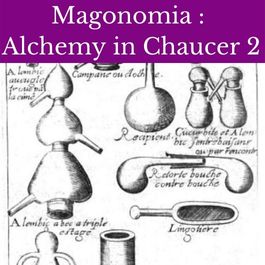
In this excerpt from Chaucer the main characters area simple priest and a skilled con artist, who is a canon. I’ve cut out a lot of the setup. The two men have met, the conman has engaged his mark in conversation, and they have travelled to the priest’s home.
“Sir,” quoth he to the priest, “let your man go
For quicksilver, that we it had anon;
And let him bringen ounces two or three;
And when he comes, as faste shall ye see
A wondrous thing, which ye saw ne’er ere this.”
“Sir,” quoth the priest, “it shall be done, y-wis.”
He bade his servant fetche him this thing,
And he all ready was at his bidding,
And went him forth, and came anon again
With this quicksilver, shortly for to sayn;
And took these ounces three to the canon;
And he them laide well and fair adown,
And bade the servant coals for to bring,
That he anon might go to his working.
The coales right anon weren y-fet,
And this canon y-took a crosselet
Out of his bosom, and shew’d to the priest.
[A reminder, a crosslet is what we would now call a crucible.]
“This instrument,” quoth he, “which that thou seest,
Take in thine hand, and put thyself therein
Of this quicksilver an ounce, and here begin,
In the name of Christ, to wax a philosopher.
There be full few, which that I would proffer
To shewe them thus much of my science;
For here shall ye see by experience
That this quicksilver I will mortify,
Right in your sight anon withoute lie,
And make it as good silver, and as fine,
As there is any in your purse, or mine,
Or elleswhere; and make it malleable,
And elles holde me false and unable
Amonge folk for ever to appear.
[“Mortifying” quicksilver is adding acid to it. Oddly enough the usual product of adding nitric acid to quicksilver is mercury fulminate, which is an explosive.]
I have a powder here that cost me dear,
Shall make all good, for it is cause of all
My conning, which that I you shewe shall.
Voide your man, and let him be thereout;
And shut the door, while we be about
Our privity, that no man us espy,
While that we work in this philosophy.”
All, as he bade, fulfilled was in deed.
This ilke servant right anon out yede,
And his master y-shut the door anon,
And to their labour speedily they gon.
This priest, at this cursed canon’s bidding,
Upon the fire anon he set this thing,
And blew the fire, and busied him full fast.
And this canon into the croslet cast
A powder, I know not whereof it was
Y-made, either of chalk, either of glass,
Or somewhat ellse, was not worth a fly,
To blinden with this priest; and bade him hiee
The coals for to couchen all above lay in order
The croslet; “for, in token I thee love,”
Quoth this canon, “thine owen handes two
Shall work all thing that here shall be do’.”
[This is a basic principle of close magic for con artistry. The mark picks the card, or choses which cup the ball’s under. The trick has already happened by the time they are allowed to touch the materials, so it only aids the verisimilitude.]
”Grand mercy,” quoth the priest, and was full glad,
And couch’d the coales as the canon bade.
And while he busy was, this fiendly wretch,
This false canon (the foule fiend him fetch),
Out of his bosom took a beechen coal,
In which full subtifly was made a hole,
And therein put was of silver limaile.
[Limaile is shavings.]
An ounce, and stopped was withoute fail
The hole with wax, to keep the limaile in.
And understande, that this false gin
Was not made there, but it was made before;
And other thinges I shall tell you more,
[Gin here means “device”, like a cotton gin, not the drink.]
[…]
But take heed, Sirs, now for Godde’s love.
He took his coal, of which I spake above,
And in his hand he bare it privily,
And while the prieste couched busily
The coales, as I tolde you ere this,
This canon saide, “Friend, ye do amiss;
This is not couched as it ought to be,
But soon I shall amenden it,” quoth he.
“Now let me meddle therewith but a while,
For of you have I pity, by Saint Gile.
Ye be right hot, I see well how ye sweat;
Have here a cloth, and wipe away the wet.”
[And that’s the misdirection.]
And while that the prieste wip’d his face,
This canon took his coal, — with sorry grace, —
And layed it above on the midward attend him!
Of the croslet, and blew well afterward,
Till that the coals beganne fast to brenn.
“Now give us drinke,” quoth this canon then,
“And swithe all shall be well, I undertake.
Sitte we down, and let us merry make.”
And whenne that this canon’s beechen coal
Was burnt, all the limaile out of the hole
Into the crosselet anon fell down;
And so it muste needes, by reasoun,
Since it above so even couched was;
But thereof wist the priest no thing, alas!
He deemed all the coals alike good,
For of the sleight he nothing understood.
And when this alchemister saw his time,
“Rise up, Sir Priest,” quoth he, “and stand by me;
And, for I wot well ingot have ye none;
Go, walke forth, and bring me a chalk stone;
For I will make it of the same shape
That is an ingot, if I may have hap.
Bring eke with you a bowl, or else a pan,
Full of water, and ye shall well see than
How that our business shall hap and preve
And yet, for ye shall have no misbelieve
Nor wrong conceit of me, in your absence,
I wille not be out of your presence,
But go with you, and come with you again.”
[So, the ingot here is the mould, not the bar of metal we draw from the mould. Note that the trick being done, the magician can say “To prove I’m not doing anything untoward I will be with you the whole time.”
The chamber-doore, shortly for to sayn,
They opened and shut, and went their way,
And forth with them they carried the key;
[So, the trick is locked in a box, the key of which is held by the mark.]
And came again without any delay.
Why should I tarry all the long day?
He took the chalk, and shap’d it in the wise
Of an ingot, as I shall you devise;
I say, he took out of his owen sleeve
A teine of silver (evil may he cheve!)
[Here we see a fault in the magician’s form. The trick’s done. There is silver in the quicksilver. There’s no need to do any of this secondary business. A teine is a small piece. “Cheve” is an outcome, like an achievement.]
Which that ne was but a just ounce of weight.
And take heed now of his cursed sleight;
He shap’d his ingot, in length and in brede
Of this teine, withouten any drede,
So slily, that the priest it not espied;
And in his sleeve again he gan it hide;
[So, he pops an ingot out of his sleeve, uses it to shape the mould, then drops it back. He doesn’t need to do any of that, and the manipulation to carve out a chalk stone to make a mould isn’t worth it. He could just as well give the man a lump of silver from the pot, or melt it into an ingot before him. In the next few lines, remember that when he puts the “matter in the ingot”, the matter is the melted metal and the ingot’s the mould, not the piece of silver in his sleeve, which Chaucer calls a tiene. That being said, the water bath in which the chalk is cooled is discoloured by the process, so the man needs to “grope” in it for the silver. If the magician wanted to, he could just have dropped the silver from his sleeve into the water vessel, as he does later.
And from the fire he took up his mattere,
And in th’ ingot put it with merry cheer;
And in the water-vessel he it cast,
When that him list, and bade the priest as fast
Look what there is; “Put in thine hand and grope;
There shalt thou finde silver, as I hope.”
What, devil of helle! should it elles be?
Shaving of silver, silver is, pardie.
He put his hand in, and took up a teine
Of silver fine; and glad in every vein
Was this priest, when he saw that it was so.
“God’s blessing, and his mother’s also,
And alle hallows, have ye, Sir Canon!”
Saide this priest, “and I their malison
But, an’ ye vouchesafe to teache me
This noble craft and this subtility,
I will be yours in all that ever I may.”
[All Hallows means “by all the saints”, and Hallowe’en is called All Hallows Eve because its the night before the feast of the saints who do not have their own individual days in the church’s calendar. A malison is a spoken curse, literally the same as a slightly later word, “malediction”.]
Quoth the canon, “Yet will I make assay
The second time, that ye may take heed,
And be expert of this, and, in your need,
Another day assay in mine absence
This discipline, and this crafty science.
Let take another ounce,” quoth he tho,
“Of quicksilver, withoute wordes mo’,
And do therewith as ye have done ere this
With that other, which that now silver is. “
The priest him busied, all that e’er he can,
To do as this canon, this cursed man,
Commanded him, and fast he blew the fire
For to come to th’ effect of his desire.
And this canon right in the meanewhile
All ready was this priest eft to beguile,
and, for a countenance, in his hande bare
An hollow sticke (take keep and beware);
Of silver limaile put was, as before
Was in his coal, and stopped with wax well
For to keep in his limaile every deal.
And while this priest was in his business,
This canon with his sticke gan him dress
To him anon, and his powder cast in,
As he did erst (the devil out of his skin
Him turn, I pray to God, for his falsehead,
For he was ever false in thought and deed),
And with his stick, above the crosselet,
That was ordained with that false get,
He stirr’d the coales, till relente gan
The wax against the fire, as every man,
But he a fool be, knows well it must need.
And all that in the sticke was out yede,
And in the croslet hastily it fell.
Now, goode Sirs, what will ye bet than well?
When that this priest was thus beguil’d again,
[To us, this seems like he’s doing the trick the same way twice, but not to the audience. Remember that for the canon, the first coal that hid the silver was, as far as he knew, his own coal. In this case, the priest is saying “I am using this perfectly normal stick.” but if the canon were to trace his memory afterward, the assumption that the technique was the same both times would hide the stick’s participation. “I am using this perfectly normal stick.” is subverted in modern magic, because the wand is assumed to be part of the trick. Actually it’s often the misdirection – it really is a perfectly normal stick.
This is the version of the con I first heard of, and it differed slightly. The equipment here has coals above and metal melting out below: the version I’d seen was for gold in a more conventional cauldron. It involved the magician stirring his material with an iron spoon that had a hollow stem, again filled with gold and stoppered with wax that melted out. This is perhaps a better method, as the canon, here, needs to make sure the priest is not looking when his vessel disintegrates and drains. In the cauldron and spoon method, the matter in the cauldron being opaque, that part of the trick is hidden from the audience.]
Supposing naught but truthe, sooth to sayn,
He was so glad, that I can not express
In no mannere his mirth and his gladness;
And to the canon he proffer’d eftsoon
Body and good. “Yea,” quoth the canon soon,
“Though poor I be, crafty thou shalt me find;
I warn thee well, yet is there more behind.
Is any copper here within?” said he.
“Yea, Sir,” the prieste said, “I trow there be.”
“Elles go buy us some, and that as swithe.
Now, goode Sir, go forth thy way and hie thee.”
He went his way, and with the copper came,
And this canon it in his handes name,
And of that copper weighed out an ounce.
Too simple is my tongue to pronounce,
As minister of my wit, the doubleness
Of this canon, root of all cursedness.
He friendly seem’d to them that knew him not;
But he was fiendly, both in work and thought.
It wearieth me to tell of his falseness;
And natheless yet will I it express,
To that intent men may beware thereby,
And for none other cause truely.
He put this copper in the crosselet,
And on the fire as swithe he hath it set,
And cast in powder, and made the priest to blow,
And in his working for to stoope low,
As he did erst, and all was but a jape;
Right as him list the priest he made his ape.
And afterward in the ingot he it cast,
And in the pan he put it at the last
Of water, and in he put his own hand;
And in his sleeve, as ye beforehand
Hearde me tell, he had a silver teine;
He silly took it out, this cursed heine
(Unweeting this priest of his false craft),
And in the panne’s bottom he it laft
And in the water rumbleth to and fro,
And wondrous privily took up also
The copper teine (not knowing thilke priest),
And hid it, and him hente by the breast,
[So, the priest seems determined to do the trick three times and in different ways. There’s a bit of art to this: it makes it harder to work out how the trick was done afterward, because the mark tends to assume the same method was used in each iteration.]
And to him spake, and thus said in his game;
“Stoop now adown; by God, ye be to blame;
Helpe me now, as I did you whilere;
Put in your hand, and looke what is there.”
This priest took up this silver teine anon;
And thenne said the canon, “Let us gon,
With these three teines which that we have wrought,
To some goldsmith, and weet if they be aught:
For, by my faith, I would not for my hood worth anything
But if they were silver fine and good,
And that as swithe well proved shall it be.”
Unto the goldsmith with these teines three
They went anon, and put them in assay
To fire and hammer; might no man say nay,
But that they weren as they ought to be.
[Assay is the process of testing metal.]
This sotted priest, who gladder was than he?
Was never bird gladder against the day;
Nor nightingale in the season of May
Was never none, that better list to sing;
Nor lady lustier in carolling,
Or for to speak of love and womanhead;
Nor knight in arms to do a hardy deed,
To standen in grace of his lady dear,
Than had this priest this crafte for to lear;
And to the canon thus he spake and said;
“For love of God, that for us alle died,
And as I may deserve it unto you,
What shall this receipt coste? tell me now.”
“By our Lady,” quoth this canon, “it is dear.
I warn you well, that, save I and a frere,
In Engleland there can no man it make.”
”No force,” quoth he; “now, Sir, for Godde’s sake,
What shall I pay? telle me, I you pray.”
“Y-wis,” quoth he, “it is full dear, I say.
Sir, at one word, if that you list it have,
Ye shall pay forty pound, so God me save;
And n’ere the friendship that ye did ere this
To me, ye shoulde paye more, y-wis.”
This priest the sum of forty pound anon
Of nobles fet, and took them every one
To this canon, for this ilke receipt.
All his working was but fraud and deceit.
[A noble was a gold coin from the time of Edward the Third. It was 80 pence, or a third of a pound.]
“Sir Priest,” he said, “I keep to have no los
Of my craft, for I would it were kept close;
And as ye love me, keep it secre:
For if men knewen all my subtlety,
By God, they woulde have so great envy
To me, because of my philosophy,
I should be dead, there were no other way.”
“God it forbid,” quoth the priest, “what ye say.
Yet had I lever spenden all the good
Which that I have (and elles were I wood),
Than that ye shoulde fall in such mischief.”
“For your good will, Sir, have ye right good prefe,”
Quoth the canon; “and farewell, grand mercy.”
He went his way, and never the priest him sey
After that day; and when that this priest should
Maken assay, at such time as he would,
Of this receipt, farewell! it would not be.
Lo, thus bejaped and beguil’d was he;
Thus made he his introduction
To bringe folk to their destruction.
[Let’s skip down to the bit where Chaucer drops some names.]
Lo, thus saith Arnold of the newe town,
As his Rosary maketh mentioun,
He saith right thus, withouten any lie;
“There may no man mercury mortify,
But it be with his brother’s knowledging.”
[This is a reference to the Rosarium Philosophorum of Arnaldus Villanovanus, a French alchemist.]
Lo, how that he, which firste said this thing,
Of philosophers father was, Hermes;
[This is not the god, it’s Hermes Trismegistus. At this stage he was though to be the counsellor of Osiris and the inventor of writing, so he’s basically Thoth, which gets him back to godhood. He was believed to have written a book on the philosopher’s stone.]
He saith, how that the dragon doubteless
He dieth not, but if that he be slain
With his brother. And this is for to sayn,
By the dragon, Mercury, and none other,
He understood, and Brimstone by his brother,
That out of Sol and Luna were y-draw.
“And therefore,” said he, “take heed to my saw.
[A “saw” is a saying]
Let no man busy him this art to seech,
But if that he th’intention and speech
Of philosophers understande can;
And if he do, he is a lewed man.
For this science and this conning,” quoth he,
“Is of the secret of secrets pardie.”
“The Secret of Secrets” is another book of alchemical knowledge. Folklorisitcally, it’s a letter from Aristotle to his student, Alexander the Great. Oddly, it’s the only one of the books listed here I’ve actually read. It was some years ago, but I couldn’t find anything immediately useful as a podcast topic.
Also there was a disciple of Plato,
That on a time said his master to,
As his book, Senior, will bear witness,
And this was his demand in soothfastness:
“Tell me the name of thilke privy stone.”
And Plato answer’d unto him anon;
“Take the stone that Titanos men name.”
“Which is that?” quoth he. “Magnesia is the same,”
[So, “thilke privy” means the “stone that is secret”. Magnesia was an area that interested Plato a lot: he suggested his perfect republic would be founded there. The weird stone from there produces what we now call magnesium. It also produces manganese. These two were both called magnesium in period, one “white” and one “black” magnesium, and they were believed to be the male and female variants of the same rock. The same area also produces magnetite, by the way, so some of the stones in the area were magnets, which alchemists though were incredibly neat. It’s not what the yeoman means here, by the way.]
Saide Plato. “Yea, Sir, and is it thus?
This is ignotum per ignotius.
What is Magnesia, good Sir, I pray?”
“It is a water that is made, I say,
Of th’ elementes foure,” quoth Plato.
“Tell me the roote, good Sir,” quoth he tho,
“Of that water, if that it be your will.”
[The Latin bit there, “ignotium per ignotius” means to answer an unknown with another unknown. “What’s the stone?” “Magnesia!” “What’s Magnesia?” “A name I made up for a thing I made.” Plato says it’s a water of the four elements. This is one of the ways of getting the quintessence, the elixir, the fifth element. Another way is to be a meat popiscle that drives a cab in the 23rd Century, but Plato was not a fan of French cinema.]
“Nay, nay,” quoth Plato, “certain that I n’ill.
The philosophers sworn were every one,
That they should not discover it to none,
Nor in no book it write in no mannere;
For unto God it is so lefe and dear,
That he will not that it discover’d be,
But where it liketh to his deity
Man for to inspire, and eke for to defend’
Whom that he liketh; lo, this is the end.”
Then thus conclude I, since that God of heaven
Will not that these philosophers neven
How that a man shall come unto this stone,
I rede as for the best to let it gon.
For whoso maketh God his adversary,
As for to work any thing in contrary
Of his will, certes never shall he thrive,
Though that he multiply term of his live.
And there a point; for ended is my tale.
God send ev’ry good man boot of his bale.
[So, God doesn’t want humans to have the secret of the elixir. It’s rather like the Peaches of Immortality in that respect. It’s there, but it’s not for you, you rising ape. The last line means “may everyone find a cure for his misfortunes.”
 Games From Folktales