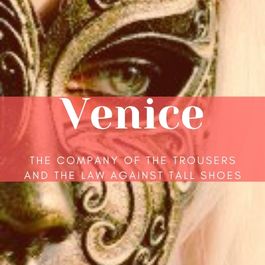
A not-very secret society serving the Doge and Dogaressa directly, that overseas festivals, Originally they were called the Order of the Beret because of their cool hats. Later they changed the name to the Society of the Sock, or perhaps Hose. Edgecum Staley says there were 40 societies, but they were likely contemperaneous. A handful may have existed at any timer, and each replaced as it dissolved with a replacement, totalling about forty eventually.
The company was reconstituted in the 1980s and overseas the modern Venetian Carnevale.
***
An obvious and visible token of the opulent greatness of the new century was the foundation of the famous ” Compagnia delta Calza,” directly under the auspices of the stylish Doge and fashionable Dogaressa, old folks as they really were.
This remarkable Society took its rise at the period of the pageants held during the first year of Doge Steno’s rule. The designation ” Calza” was quite an arbitrary choice for the purview of the Compagnia had regard to all and every detail of dress and manner. It was first entitled ” della Berretta,”— “Company of the Cap,” but the woven silken or worsted grarment which clung- to and exhibited the whole figure, was the emphatic feature of the sumptuary modes—hence came ” Calza,”—”Company of the Tights.”
The society or union consisted of a number of clubs of young men—gay, rich and physically fit.
The officers of the Compagnia consisted of a Prior or chief,—who went about in a gorgeous costume of cloth of gold,—two Councillors, treasurer, chaplain, painter, sculptor, architect, poet, annalist, and a notary. The Compagnia consisted of clubs, and each club bore a distinguishing name. Immortali, Realty, Perpeiui, Semprevivi, Pavoni, Ortolani, etc., etc.,—there were forty of them. Every member wore striped silk tights, embroidered in gold and coloured silks with pearls and gems : each club had its special arrangement of stripes. Their doublets of silk velvet embroidered with gold, fitted close to the body, and bore the badge of the particular club. They had slashed sleeves through which puffings of fine white linen shirts
were pulled. Upon their shoulders they wore short cloaks of cloth of gold or crimson damask velvet, lined with choice fur. Their flowing locks of hair were restrained under jaunty little caps of red or black silk or cloth, with a handsome jewel at the side and a heron’s feather. Their pointed shoes were of fine red leather pierced at the toes and adorned with gold and pearls. Waist – belts of leather, jewelled and embroidered, with beautiful scarcelle, or pouches, at the side, a golden chain bearing a jewelled pendant, and rings on the fingers completed the superb costumes.
Women associates were freely admitted, upon the hems of whose tight fitting silken petticoats,
was embroidered in gold, the word ” Calza ” ; foreigners also were admitted to honorary membership. The gentildonne wore long sleeves, —lined with fur, and beautifully worked cinctures of gold and embroidery : their hair was arranged in plaits and rolled under golden nets, and their feet were shod in jewelled golden shoes. Their fine gold chains of interlaced and jewelled rings encircled throats and breasts.
The purpose of the ” Conipagnia della Calza” was however not merely the wearing of fine clothes, but the direction of State pageants, the reception of foreign princes and ambassadors, the performance of spectacular games and plays, and attendance at solemn Ecclesiastical functions. They also assisted at weddings, birthdays, baptisms, and funerals, and acted as elegant and audacious State masters of ceremonies in general.
With enthusiasm, each Maundy-Thursday, the gay young fellows entered the annual Caccia del Tori, which had originated after the first defeat of Friuli in 1 164. Three other dates were added,—Santa Marta’s day, the first Monday in September, and the first in October, and the “rings” were on the Lido and in the Piazza. Later on every campi had its Caccia, and, degenerating as such festivals usually do, the places of the gentildonne were taken by courtesans dressed, masked, and mannered.
The love of sumptuous dress gave a grand impetus to Venetian trade, but it led of course to many corruptions and exaggerations,—one of these was the wearing of enormously high pattens. The condition of the calle unfortunately required some such protection from mud
and dirt, but women went about on shoe-stilts of poplar wood and leather which effectively dwarfed the slim tall figures of the men. At last an edict was issued which forbade this absurd fashion, especially in the case of pregnant women :
This fashion, by the way, led to many ludicrous situations, for many a gallant admirer of a calle beauty, tall, commanding and superfine, — discovered her in her boudoir reduced to natural if
disappointing dimensions, and forthwith declined her charms, and made a not too dignified exit !
 Games From Folktales