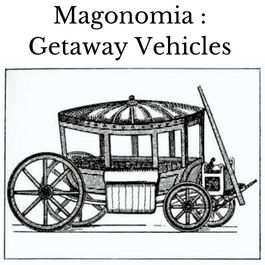
In early Elizabeth’s England, if you want to make a fast getaway, you use a horse, except if you are in London, where you slope down to the river and embark surreptitiously, with the help of a convenient waterman. You don’t, surprisingly, use a carriage. That being said, at the end I’ll discuss some ways to trick out a carriage.
Initially the lack of carriages is purely technological: no-one has them in England before 1555. They did have working vehicles like drays and wagons. For transport they have huge carts, richly furnished and slow as molasses, that are used for parades and royal progresses. These were the descendants of a Saxon invention, which was basically a wagon with a hammock in it for moving people to frail to ride. Americans thinking of the carts in Oregon Trail aren’t far off – just add a lot of fabric and gild anything that’s still visible.
Even after the earliest carriages are bought into England, they are not popular in some circles. Part of the reason for this is practical: the roads are terrible and suspension is rudimentary. The second, is that they are initially considered effeminate, and then later considered debauched. One poet, slightly after the reign, asked if it was carriages which popularized tobacco or the other way around. So, they do become available as conveyances late in the reign. Like so many other industries, carriagemaking takes a leap forward when all of the Dutch refugees show up and establish new manufactures, following the war of independence with Spain.
Another problem is mechanical. Steering systems are rudimentary. On a fixed axle, the wheels can’t move at different speeds without slippage, so cornering is slow and wide compared to modern vehicles, even modern carriages. Single-axle carts can be a bit more nimble because effectively they sway about on the traces between the animals drawing the cart and the vehicle. Having multiple fixed axles makes this far worse. That doesn’t matter on drays carting crops, but it does create a problem for a dashing agent wanting to tear around a corner while flinging smoke bombs at her foes.
The earliest, and by the end of the reign, really only, solution was to mount the front axle on a pin, so that the front two wheels could swivel to follow the horses pulling the carriage. This has a couple of problems though. It compromises the tray of the wagon, and it makes it unstable.
The surface area of a wagon’s tray determines how much stuff it can carry, and therefore how much cargo you could haul per trip. Once you’ve decided that your cargo is actually some people in seats, you can make the axles a bit longer than the tray of the wagon to give yourself some more room to manoeuvre. You can also make the body of the carriage “waisted” that is, have it narrower where the wheels are. Some carriages are narrower from the bottom to the top (which makes them even more top-heavy than you’d image), while some are wider at the back (since the rear axle does not steer). Eventually, in later carriages, the front axle is moved so far forward of the passenger box that part of the wheels can go under the body of the carriage. Another thing you can do is make the front wheels smaller. This again lets you get them closer to a full rotation in the space you have between them being parallel to and them striking the side of the carriage (or the guard that stops that happening). This also helps in designs where the axle has been moved forward: small wheels can go under the connection
The second problem is that from a stability perspective, you’ve basically turned the carriage into a big tricycle. On a wagon with two dead axles, when you hit a pothole with one of the forward wheels, that wheel dips a bit, but your other front wheel acts as a sort of drag to stop it being knocked too far off line. With a pivoting front axle, things work the other way: hitting a pothole means both of your front wheels swerve. This is why in carriages, the person of honour sits at the back facing forwards: they get jolted about less. Similarly, if you are struck in an accident, your wheels aren’t necessarily holding the corners of the carriage up: effectively they are holding up a top-heavy “T” shape. This is why so many carriages flip over, even in what modern people would consider low speed collisions.
Time to crack out the really weird bit of history. If you don’t want to ride, what’s the posh way of getting from place to place early on? The horse litter. A horse litter is basically a carriage, but instead of wheels it has a horse at the front and back. This uses the knees of the horses as shock absorbers, so it’s considered far more suitable for ladies and the unwell. Sometimes they are lead by a man who is walking, sometimes the front horse has a rider. Sometimes the rear horse is replaced by people, but that’s really fancy and pointless for actual travel. It’s how Catherine of Aragon entered London though – horse at the front and eight guys at the back.
Elizabeth did have a carriage (actually, it might have been a coach, which is basically a carriage with four corner posts). Its sides were made of wicker and the panels could be peeled so she was visible to people. There wasn’t any coach glazing at the time, so there was no view directly forward for the passengers. It was likely slow, as it was drawn by two horses. Coaches with six horses weren’t known in England until the reign of James I, so there was no careening about. It was also profoundly uncomfortable: the box (where the passengers sit) was probably hanging on chains or leather straps rather than directly to the axle, but they still are terrible. Elizabeth used to ride to places, then switch to her coach for parades, then swap back.
As an example, Elizabeth II has a gilded coach for state occasions which weighs four tons, and is so uncomfortable to ride in that we have testimony at how terrible it is from four monarchs. When people who have done blue water naval service in wooden ships tell you this was the worst ride of their life, it must have been terrible. Liz Two refused to use it in her latest Jubilee parade because she’s in her eighties. This is presumably why her new coaches have modern shock absorbers, air conditioning and power windows: because she already has one that’s historical but rubbish.
The source I’m using (Carriages and Coaches: Their History and Evolution by Ralph Straus) says that “by 1585 many of the nobility and some wealthy commoners owned private coaches, and, indeed, certain enterprising tradesmen, as will appear, let other coaches on hire at so much per day…Indeed, every one of any wealth was eager to possess them. A private coach settled any doubts as to your quality. It was a new fashion, a new excitement…From such details it is possible to imagine what this and other coaches of the time were like. You figure a huge, gaudy, curtained apparatus with projecting sides and incomplete panels, large enough to contain a fair-sized bed, hung roughly from four posts, and capable of being dragged at little better than a snail’s pace—“four-wheeled Tortoyses” Taylor calls them—along roads hardly worthy of the name. Twenty miles a day was considered good going.
The coachman, as we learn from the water-poet, was “mounted (his fellow-horses and himselfe being all in a finery) with as many varieties of laces, facings, Clothes and Colours as are in the Rainebowe.” Nor was he over-polite, particularly if the coach he drove was hired.
I’d break in at this point to note that although you could have your coach kept somewhere for your use when required., or you could hire a coach by the day, ranks of hackney coaches, for hire by the trip, don’t appear before 1633, with the first one being in the Strand. At least that’s in England: over in France they seem to have sprung up in front of popular taverns, so they have much the same system we use in Australia today. Back to our Straus.
They seem to have thought that their finery allowed them to treat the pedestrians with but scant respect. And no wonder these “way-stopping whirligigges,” as Taylor calls the coaches, surprised the inhabitants. When one of them was seen for the first time, “some said it was a great Crab-shell brought out of China, and some imagin’d it to be one of the Pagan Temples in which the Cannibals adored the devill.” For some time, indeed, the coaches must have given the common folk something to think about.. In fact, the coach, according to poor Taylor, is directly responsible for every calamity from which the country has suffered since its introduction. Leather has become dearer, the horses in their traces are being prostituted, and there is a “universal decay of the best ash-trees.”
As an aside, sedan chairs seem to date from around Elizabeth’s death. The historian I’m quoting doubtfully records it as being due to Buckingham again, saying he saw them in Spain when he visited it with Prince Charles and bought three back with him, supposedly. Eventually Sir Saunder Durcombe, who was an ally of Buckingham’s, is given a sedan chair monopoly for fourteen years. At much the same time, coaches were banned from London’s streets unless the occupants were traveling at least three miles beyond the city. This was profitable for a while, but people then just started ignoring the law about coaches.
Note that right of way is odd at this time: basically “Rich Dudes Go First”, based on the idea of precedence. There’s a humorous pamphlet put out about how a sedan chair operator and a coachman are arguing who should wait for the other, on the basis that the coach is in the service or a duke, but that the chair is not empty but contains an actual knight at the very moment. After a morning’s argument a beer cart (a two-wheeler) claims precedence over both of them, as having come to the country in the time of Henry VII, and being of far greater use. You’ll note that by Sherlock Holmes’s time, hackney cabs were also two wheelers? It makes them better able to navigate around coaches in traffic.
Tricking out your carriage
The first thing to consider is where you might stash equipment in a carriage. By tradition, a lone driver carries a gun within his seat, and if he has a driving partner, they sit up front with a gun. The shotgun has, however, not yet been invented, so you can’t call shotgun on the seat outside. The box in which passengers ride also provides space for mechanisms and armaments, although line of sight to fire is not particularly good. The roof of the carriage could be used to store material, or could have a hole in it to allow material inside to be dispensed. At the back many carriages have a storage box, the ancestor of the modern car boot, which might also have destructive elements. A difference from the modern car that might be useful is that carriages have a very high comparative clearance. The carriage doesn’t need a drive shaft or fuel tank, so there’s a lot of free space under the floor, between the axles.
As to what your weapons need do: carriages are already terrible, so you just need to make them slightly worse. Making the road slippery, making it difficult to see and making it hard to steer may all work, without the need to shoot the coachman. You can’t shot out the tyres of a coach, because it doesn’t have them: wheels are made of wood with little metal plates nailed on. Steel hoops around wheels haven’t been invented yet. You can, however, crack a wheel spoke, and that can cause dangerous accidents, because the carriage is, again, top-heavy and unstable.
A problem with using a carriage as a weapons platform is that horses spook very easily, even some trained horses. Modern horses are perfectly willing to shy at a shadow or a piece of litter, which is why they wear blinders to stop them seeing peripherally. Their forebears were even likely to bolt if they heard a sudden explosion behind them. People may imagine that carriage accidents were rare, because horses will not, for example, run themselves into walls, but the opposite is the case: horses, when startled, don’t really think things through at all. They just run and hope for the best. In a chase scene you might not be too bothered by your horses sprinting, but it makes steering wider and worse, and it uses up your horse’s energy, so you can’t sprint again until your horses has caught its breath. There are ways to make horses go faster artificially – various tonics used by horseleeches to win races, but during the thick of combat or the dash of the chase, do you want to be trying to force ginger into your horse’s bottom?
 Games From Folktales