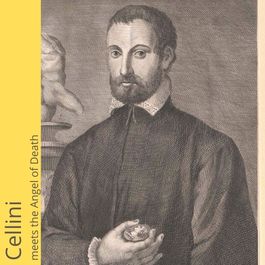
A couple of quick comments, beyond the usual reminder to look at how many times Cellini tells you that he is better than other people, including you, We have some characters who, for context, need a little bit more description. The angel of death he meets is not the Jewish angel of death covered in Kabbalah or the Christian angel of death from The Church. It seems to be Charon, which shows that Cellini has been reading his Dante. From an Ars Magica perspective he may be an initiate of the Vigilian mysteries: that is he expects to go to Dante’s inferno and be carried there by the guy who rows people across the river Styx. This is not, of course, a heterodox religious position in Mythic Europe.
Some other people: there’s a character called Giorgio later in the story. Cellini accuses him of a crime and then there is this and back and forth. This Giorgio is Vasari, who later wrote “The Lives of the Artists”: a key resource of biography for Renaissance artists. I have a copy of it on my shelf. I used it when I was first looking to write up Sanctuary of Ice. I believe it may be from where I stole the idea that House Jerbiton believes that “beauty is all that pleases”: anyway he and Cellini cordially hated each other. Actually given it was Cellini, he probably didn’t cordially hate him – he probably wanted to murder him but couldn’t see his way clear to doing it. He beats up people on a pretty regular basis in these stories. The last person mentioned is Felice who is a servant or journeyman and later partner. He’s not only Cellini’s partner in a financial sense and in a trade sense, they are sexual partners as well. This comes out later during a court proceeding where he’s charged for what was then considered immoral behaviour
Cellini is, in his own story so far as we can tell, polyamorous and bisexual. This doesn’t seem to cause him any real difficulty, with the exception of a couple of ladies who sue him for something that’s the equivalent of breach of promise. They also, likely truthfully, charged him with using them in the Italian manner, which he says he never did at all, and how dare anyone suggest it, and he would gladly fight people who suggested such a thing.
And now on to Cellini’s meeting with the Angel of Death. The Librivox recording i’m using here is from quite early in the Librivox Project. I’d like to thank the two recorders Sibella Denton and PPRay. One recording is lower quality, just technically, than some of the others that I’ve used from that site. I did want to warn you in case you thought that something had changed in your headphones or speakers there’s a lot more background crackle
LXXXI
…That very day, which was a Thursday, I received from Rome a full safe-conduct from the Pope, with advice to go there at once and get the pardon of Our Lady’s feast in mid-August, in order that I might clear myself from the penalties attaching to my homicide…
ON the journey to Rome I carried with me that handsome arquebuse which the Duke gave me; and very much to my own pleasure, I used it several times by the way, performing incredible feats by means of it. The little house I had in Strada Giulia was not ready; so I dismounted at the house of Messer Giovanni Gaddi, clerk of the Camera, to whose keeping I had committed, on leaving Rome, many of my arms and other things I cared for. So I did not choose to alight at my shop, but sent for Felice, my partner, and got him to put my little dwelling forthwith into excellent order. The day following, I went to sleep there, after well providing myself with clothes and all things requisite, since I intended to go and thank the Pope next morning.
I had two young serving-lads, and beneath my lodgings lived a laundress who cooked extremely nicely for me. That evening I entertained several friends at supper, and having passed the time with great enjoyment, betook myself to bed. The night had hardly ended, indeed it was more than an hour before daybreak, when I heard a furious knocking at the house-door, stroke succeeding stroke without a moment’s pause. Accordingly I called my elder servant, Cencio [1] (he was the man I took into the necromantic circle), and bade him to go and see who the madman was that knocked so brutally at that hour of the night. While Cencio was on this errand, I lighted another lamp, for I always keep one by me at night; then I made haste to pass an excellent coat of mail over my shirt, and above that some clothes which I caught up at random. Cencio returned, exclaiming: “Heavens, master! it is the Bargello and all his guard; and he says that if you do not open at once, he will knock the door down. They have torches, and a thousand things besides with them!” I answered: “Tell them that I am huddling my clothes on, and will come out to them in my shirt.” Supposing it was a trap laid to murder me, as had before been done by Signor Pier Luigi, I seized an excellent dagger with my right hand, and with the left I took the safe-conduct; then I ran to the back-window, which looked out on gardens, and there I saw more than thirty constables; wherefore I knew that I could not escape upon that side. I made the two lads go in front, and told them to open the door exactly when I gave the word to do so. Then taking up an attitude of defence, with the dagger in my right hand and the safe-conduct in my left, I cried to the lads: “Have no fear, but open!” The Bargello, Vittorio, and the officers sprang inside at once, thinking they could easily lay hands upon me; but when they saw me prepared in that way to receive them, they fell back, exclaiming: “We have a serious job on hand here!” Then I threw the safe-conduct to them, and said: “Read that! and since you cannot seize me, I do not mean that you shall touch me.” The Bargello upon this ordered some of his men to arrest me, saying he would look to the safe-conduct later. Thereat I presented my arms boldly, calling aloud: “Let God defend the right! Either I shall escape your hands alive, or be taken a dead corpse!” The room was crammed with men; they made as though they would resort to violence; I stood upon my guard against them; so that the Bargello saw he would not be able to have me except in the way I said. Accordingly he called his clerk, and while the safe-conduct as being read, he showed by signs two or three times that he meant to have me secured by his officers; but this had no effect of shaking my determination. At last they gave up the attempt, threw my safe-conduct on the ground, and went away without their prize.
LXXXIII
WHEN I returned to bed, I felt so agitated that I could not get to sleep again. My mind was made up to let blood as soon as day broke. However, I asked advice of Messer Gaddi, and he referred to a wretched doctor-fellow he employed, who asked me if I had been frightened. Now, just consider what a judicious doctor this was, after I had narrated an occurrence of that gravity, to ask me such a question! He was an empty fribbler, who kept perpetually laughing about nothing at all. Simpering and sniggering, then, he bade me drink a good cup of Greek wine, keep my spirits up, and not be frightened. Messer Giovanni, however, said: “Master, a man of bronze or marble might be frightened in such circumstances. How much more one of flesh and blood!” The quack responded: “Monsignor, we are not all made after the same pattern; this fellow is no man of bronze or marble, but of pure iron.” Then he gave one of his meaningless laughs, and putting his fingers on my wrist, said: “Feel here; this is not a man’s pulse, but a lion’s or a dragon’s.” At this, I, whose blood was thumping in my veins, probably far beyond anything which that fool of a doctor had learned from his Hippocrates or Galen, knew at once how serious was my situation; yet wishing not to add to my uneasiness and to the harm I had already taken, I made show of being in good spirits. While this was happening, Messer Giovanni had ordered dinner, and we all of us sat down to eat in company. I remembered that Messer Lodovico da Fano, Messer Antonio Allegretti, Messer Giovanni Greco, all of them men of the finest scholarship, and Messer Annibal Caro, who was then quite young, were present. At table the conversation turned entirely upon my act of daring. They insisted on hearing the whole story over and over again from my apprentice Cencio, who was a youth of superlative talent, bravery, and extreme personal beauty. Each time that he described my truculent behaviour, throwing himself into the attitudes I had assumed, and repeating the words which I had used, he called up some fresh detail to my memory. They kept asking him if he had been afraid; to which he answered that they ought to ask me if I had been afraid, because he felt precisely the same as I had.
All this chattering grew irksome to me; and since I still felt strongly agitated, I rose at last from table, saying that I wanted to go and get new clothes of blue silk and stuff for him and me; adding that I meant to walk in procession after four days at the feast of Our Lady, and meant Cencio to carry a white lighted torch on the occasion. Accordingly I took my leave, and had the blue cloth cut, together with a handsome jacket of blue sarcenet and a little doublet of the same; and I had a similar jacket and waistcoat made for Cencio.
When these things had been cut out, I went to see the Pope, who told me to speak with Messer Ambruogio; for he had given orders that I should execute a large piece of golden plate. So I went to find Messer Ambruogio, who had heard the whole of the affair of the Bargello, and had been in concert with my enemies to bring me back to Rome, and had scolded the Bargello for not laying hands on me. The man excused himself by saying that he could not do so in the face of the safe-conduct which I held. Messer Ambruogio now began to talk about the Pope’s commission, and bade me make drawings for it, saying that the business should be put at once in train. Meanwhile the feast of Our Lady came round. Now it is the custom for those who get a pardon upon this occasion to give themselves up to prison; in order to avoid doing which I returned to the Pope, and told his Holiness that I was very unwilling to go to prison, and that I begged him to grant me the favour of a dispensation. The Pope answered that such was the custom, and that I must follow it. Thereupon I fell again upon my knees, and thanked him for the safe-conduct he had given me, saying at the same time that I should go back with it to serve my Duke in Florence, who was waiting for me so impatiently. On hearing this, the Pope turned to one of his confidential servants and said: “Let Benvenuto get his grace without the prison, and see that his ‘moto proprio’ is made out in due form.” As soon as the document had been drawn up, his Holiness signed it; it was then registered at the Capitol; afterwards, upon the day appointed, I walked in procession very honourably between two gentlemen, and so got clear at last.
LXXXIV
FOUR days had passed when I was attacked with violent fever attended by extreme cold; and taking to my bed, I made my mind up that I was sure to die. I had the first doctors of Rome called in, among whom was Francesco da Norcia, a physician of great age, and of the best repute in Rome. I told them what I believed to be the cause of my illness, and said that I had wished to let blood, but that I had been advised against it; and if it was not too late, I begged them to bleed me now. Maestro Francesco answered that it would not be well for me to let blood then, but that if I had done so before, I should have escaped without mischief; at present they would have to treat the case with other remedies. So they began to doctor me as energetically as they were able, while I grew daily worse and worse so rapidly, that after eight days the physicians despaired of my life, and said that I might be indulged in any whim I had to make me comfortable. Maestro Francesco added: “As long as there is breath in him, call me at all hours; for no one can divine what Nature is able to work in a young man of this kind; moreover, if he should lose consciousness, administer these five remedies one after the other, and send for me, for I will come at any hour of the night; I would rather save him than any of the cardinals in Rome.”
Every day Messer Giovanni Gaddi came to see me two or three times, and each time he took up one or other of my handsome fowling-pieces, coats of mail, or swords, using words like these: “That is a handsome thing, that other is still handsomer;” and likewise with my models and other trifles, so that at last he drove me wild with annoyance. In his company came a certain Matio Franzesi and this man also appeared to be waiting impatiently for my death, not indeed because he would inherit anything from me, but because he wished for what his master seemed to have so much at heart.
Felice, my partner, was always at my side, rendering the greatest services which it is possible for one man to give another. Nature in me was utterly debilitated and undone; I had not strength enough to fetch my breath back if it left me; and yet my brain remained as clear and strong as it had been before my illness. Nevertheless, although I kept my consciousness, a terrible old man used to come to my bedside, and make as though he would drag me by force into a huge boat he had with him. This made me call out to my Felice to draw near and chase that malignant old man away. Felice, who loved me most affectionately, ran weeping and crying: “Away with you, old traitor; you are robbing me of all the good I have in this world.” Messer Giovanni Gaddi, who was present, then began to say: “The poor fellow is delirious, and has only a few hours to live.” His fellow, Mattio Franzesi, remarked: “He has read Dante, and in the prostration of his sickness this apparition has appeared to him” then he added laughingly: “Away with you, old rascal, and don’t bother our friend Benvenuto.” When I saw that they were making fun of me, I turned to Messer Gaddi and said: “My dear master, know that I am not raving, and that it is true that this old man is really giving me annoyance; but the best that you can do for me would be to drive that miserable Mattio from my side, who is laughing at my affliction, afterwards if your lordship deigns to visit me again, let me beg you to come with Messer Antonio Allegretti, or with Messer Annibal Caro, or with some other of your accomplished friends, who are persons of quite different intelligence and discretion from that beast.” Thereupon Messer Giovanni told Mattio in jest to take himself out of his sight for ever; but because Mattio went on laughing, the joke turned to earnest, for Messer Giovanni would not look upon him again, but sent for Messer Antonio Allegretti, Messer Ludovico, and Messer Annibal Caro. On the arrival of these worthy men, I was greatly comforted, and talked reasonably with them awhile, not however without frequently urging Felice to drive the old man away. Messer Ludovico asked me what it was I seemed to see, and how the man was shaped. While I portrayed him accurately in words, the old man took me by the arm and dragged me violently towards him. This made me cry out for aid, because he was going to fling me under hatches in his hideous boat. On saying that last word, I fell into a terrible swoon, and seemed to be sinking down into the boat. They say that during that fainting-fit I flung myself about and cast bad words at Messer Giovanni Gaddi, to wit, that he came to rob me, and not from any motive of charity, and other insults of the kind, which caused him to be much ashamed. Later on, they say I lay still like one dead; and after waiting by me more than an hour, thinking I was growing cold, they left me for dead. When they returned home, Mattio Franzesi was informed, who wrote to Florence to Messer Benedetto Varchi, my very dear friend, that they had seen me die at such and such an hour of the night. When he heard the news, that most accomplished man and my dear friend composed an admirable sonnet upon my supposed but not real death, which shall be reported in its proper place.
More than three long hours passed, and yet I did not regain consciousness. Felice having used all the remedies prescribed by Maestro Francesco, and seeing that I did not come to, ran post-haste to the physician’s door, and knocked so loudly that he woke him up, and made him rise, and begged him with tears to come to the house, for he thought that I was dead. Whereto Maestro Francesco, who was a very choleric man, replied: “My son, of what use do you think I should be if I came? If he is dead, I am more sorry than you are. Do you imagine that if I were to come with my medicine I could blow breath up through his guts and bring him back to life for you?” But when he saw that the poor young fellow was going away weeping, he called him back and gave him an oil with which to anoint my pulses, and my heart, telling him to pinch my little fingers and toes very tightly, and to send at once to call him if I should revive. Felice took his way, and did as Maestro Francesco had ordered. It was almost bright day when, thinking they would have to abandon hope, they gave orders to have my shroud made and to wash me. Suddenly I regained consciousness, and called out to Felice to drive away the old man on the moment, who kept tormenting me. He wanted to send for Maestro Francesco, but I told him not to do so, but to come close up to me, because that old man was afraid of him and went away at once. So Felice drew near to the bed; I touched him, and it seemed to me that the infuriated old man withdrew; so I prayed him not to leave me for a second.
When Maestro Francesco appeared, he said it was his dearest wish to save my life, and that he had never in all his days seen greater force in a young man than I had. Then he sat down to write, and prescribed for me perfumes, lotions, unctions, plasters, and a heap of other precious things. Meanwhile I came to life again by the means of more than twenty leeches applied to my buttocks, but with my body bore through, bound, and ground to powder. Many of my friends crowded in to behold the miracle of the resuscitated dead man, and among them people of the first importance.
In their presence I declared that the small amount of gold and money I possessed, perhaps some eight hundred crowns, what with gold, silver, jewels, and cash, should be given by my will to my poor sister in Florence, called Mona Liperata; all the remainder of my property, armour and everything besides, I left to my dearest Felice, together with fifty golden ducats, in order that he might buy mourning. At those words Felice flung his arms around my neck, protesting that he wanted nothing but to have me as he wished alive with him. Then I said: “If you want me alive, touch me as you did before, and threaten the old man, for he is afraid of you.” At these words some of the folk were terrified, knowing that I was not raving, but talking to the purpose and with all my wits. Thus my wretched malady went dragging on, and I got but little better. Maestro Francesco, that most excellent man, came four or five times a day; Messer Giovanni Gaddi, who felt ashamed, did not visit me again. My brother-in-law, the husband of my sister, arrived; he came from Florence for the inheritance; but as he was a very worthy man, he rejoiced exceedingly to have found me alive. The sight of him did me a world of good, and he began to caress me at once, saying he had only come to take care of me in person; and this he did for several days. Afterwards I sent him away, having almost certain hope of my recovery…
LXXXV
MY sickness had been of such a very serious nature that it seemed impossible for me to fling it off. That worthy man Maestro Francesco da Norcia redoubled his efforts, and brought me every day fresh remedies, trying to restore strength to my miserable unstrung frame. Yet all these endeavours were apparently insufficient to overcome the obstinacy of my malady, so that the physicians were in despair and at their wits’ ends what to do. I was tormented by thirst, but had abstained from drinking for many days according to the doctors’ orders. Felice, who thought he had done wonders in restoring me, never left my side. That old man ceased to give so much annoyance, yet sometimes he appeared to me in dreams.
One day Felice had gone out of doors, leaving me under the care of a young apprentice and a servant-maid called Beatrice. I asked the apprentice what had become of my lad Cencio, and what was the reason why I had never seen him in attendance on me. The boy replied that Cencio had been far more ill than I was, and that he was even at death’s door. Felice had given them orders not to speak to me of this. On hearing the news, I was exceedingly distressed; then I called the maid Beatrice, a Pistojan girl, and asked her to bring me a great crystal water-cooler which stood near, full of clear and fresh water. She ran at once, and brought it to me full; I told her to put it to my lips, adding that if she let me take a draught according to my heart’s content, I would give her a new gown. This maid had stolen from me certain little things of some importance, and in her fear of being detected, she would have been very glad if I had died. Accordingly she allowed me twice to take as much as I could of the water, so that in good earnest I swallowed more than a flask full. I then covered myself, and began to sweat, and fell into a deep sleep. After I had slept about an hour, Felice came home and asked the boy how I was getting on. He answered: “I do not know. Beatrice brought him that cooler full of water, and he has drunk almost the whole of it. I don’t know now whether he is alive or dead.” They say that my poor friend was on the point of falling to the ground, so grieved was he to hear this. Afterwards he took an ugly stick and began to beat the serving-girl with all his might, shouting out: “Ah! traitress, you have killed him for me then?” While Felice was cudgelling and she screaming, I was in a dream; I thought the old man held ropes in his hand, and while he was preparing to bind me, Felice had arrived and struck him with an axe, so that the old man fled exclaiming: “Let me go, and I promise not to return for a long while.” Beatrice in the meantime had run into my bedroom shrieking loudly. This woke me up, and I called out: “Leave her alone; perhaps, when she meant to do me harm, she did me more good than you were able to do with all your efforts. She may indeed have saved my life; so lend me a helping hand, for I have sweated; and be quick about it.” Felice recovered his spirits, dried and made me comfortable; and I, being conscious of a great improvement in my state, began to reckon on recovery.
When Maestro Francesco appeared and saw my great improvement, and the servant-girl in tears, and the prentice running to and fro, and Felice laughing, all this disturbance made him think that something extraordinary must have happened, which had been the cause of my amendment. Just then the other doctor, Bernardino, put in his appearance, who at the beginning of my illness had refused to bleed me. Maestro Francesco, that most able man, exclaimed: “Oh, power of Nature! She knows what she requires, and the physicians know nothing.” That simpleton, Maestro Bernardino, made answer, saying: “If he had drunk another bottle he would have been cured upon the spot.” Maestro Francesco da Norcia, a man of age and great authority, said: “That would have been a terrible misfortune, and would to God that it may fall on you!” Afterwards he turned to me and asked if I could have drunk more water. I answered: “No, because I had entirely quenched my thirst.” Then he turned to Maestro Bernardino, and said: “Look you how Nature has taken precisely what she wanted, neither more nor less. In like manner she was asking for what she wanted when the poor young man begged you to bleed him. If you knew that his recovery depended upon his drinking two flasks of water, why did you not say so before? You might then have boasted of his cure.” At these words the wretched quack sulkily departed, and never showed his face again.
Maestro Francesco then gave orders that I should be removed from my room and carried to one of the hills there are in Rome. Cardinal Cornaro, when he heard of my improvement, had me transported to a place of his on Monte Cavallo. The very evening I was taken with great precautions in a chair, well wrapped up and protected from the cold. No sooner had I reached the place than I began to vomit, during which there came from my stomach a hairy worm about a quarter of a cubit in length: the hairs were long, and the worm was very ugly, speckled of divers colours, green, black, and red. They kept and showed it to the doctor, who said he had never seen anything of the sort before, and afterwards remarked to Felice: “Now take care of your Benvenuto, for he is cured. Do not permit him any irregularities; for though he has escaped this time, another disorder now would be the death of him. You see his malady has been so grave, that if we had brought him the extreme unction, we might not have been in time. Now I know that with a little patience and time he will live to execute more of his fine works.” Then he turned to me and said: “My Benvenuto, be prudent, commit no excesses, and when you are quite recovered, I beg you to make me a Madonna with your own hand, and I will always pay my devotions to it for your sake.” This I promised to do, and then asked him whether it would be safe for me to travel so far as to Florence. He advised me to wait till I was stronger, and till we could observe how Nature worked in me.
LXXXVI
WHEN eight days had come and gone, my amendment was so slight that life itself became almost a burden to me; indeed I had been more than fifty days in that great suffering. So I made my mind up, and prepared to travel. My dear Felice and I went toward Florence in a pair of baskets; [1] and as I had not written, when I reached my sister’s house, she wept and laughed over me all in one breath. That day many friends came to see me; among others Pier Landi, who was the best and dearest friend I ever had. Next day there came a certain Niccolò da Monte Aguto, who was also a very great friend of mine. Now he had heard the Duke say: “Benvenuto would have done much better to die, because he is come to put his head into a noose, and I will never pardon him.” Accordingly when Niccolò arrived, he said to me in desperation: “Alas! my dear Benvenuto, what have you come to do here? Did you not know what you have done to displease the Duke? I have heard him swear that you were thrusting your head into a halter.” Then I replied: “Niccolò, remind his Excellency that Pope Clement wanted to do as much to me before, and quite as unjustly; tell him to keep his eye on me, and give me time to recover; then I will show his Excellency that I have been the most faithful servant he will ever have in all his life; and forasmuch as some enemy must have served me this bad turn through envy, let him wait till I get well; for I shall then be able to give such an account of myself as will make him marvel.”
This bad turn had been done me by Giorgetto Vassellario of Arezzo,the painter; perchance in recompense for many benefits conferred on him. I had harboured him in Rome and provided for his costs, while he had turned my whole house upside down; for the man was subject to a species of dry scab, which he was always in the habit of scratching with his hands. It happened, then, that sleeping in the same bed as an excellent workman, named Manno, who was in my service, when he meant to scratch himself, he tore the skin from one of Manno’s legs with his filthy claws, the nails of which he never used to cut. The said Manno left my service, and was resolutely bent on killing him. I made the quarrel up, and afterwards got Giorgio into Cardinal de’ Medici’s household, and continually helped him. For these deserts, then, he told Duke Alessandro that I had abused his Excellency, and had bragged I meant to be the first to leap upon the walls of Florence with his foes the exiles. These words, as I afterwards learned, had been put into Vasari’s lips by that excellent fellow, [3] Ottaviano de’ Medici, who wanted to revenge himself for the Duke’s irritation against him, on account of the coinage and my departure from Florence. I, being innocent of the crime falsely ascribed to me, felt no fear whatever. Meanwhile that able physician Francesco da Monte Varchi attended to my cure with great skill. He had been brought by my very dear friend Luca Martini, who passed the larger portion of the day with me.
LXXXVII
DURING this while I had sent my devoted comrade Felice back to Rome, to look after our business there. When I could raise my head a little from the bolster, which was at the end of fifteen days, although I was unable to walk upon my feet, I had myself carried to the palace of the Medici, and placed upon the little upper terrace. There they seated me to wait until the Duke went by. Many of my friends at court came up to greet me, and expressed surprise that I had undergone the inconvenience of being carried in that way, while so shattered by illness; they said that I ought to have waited till I was well, and then to have visited the Duke. A crowd of them collected, all looking at me as a sort of miracle; not merely because they had heard that I was dead, but far more because I had the look of a dead man. Then publicly, before them all, I said how some wicked scoundrel had told my lord the Duke that I had bragged I meant to be the first to scale his Excellency’s walls, and also that I had abused him personally; wherefore I had not the heart to live or die till I had purged myself of that infamy, and found out who the audacious rascal was who had uttered such calumnies against me. At these words a large number of those gentlemen came round, expressing great compassion for me; one said one thing, one another, and I told them I would never go thence before I knew who had accused me. At these words Maestro Agostino, the Duke’s tailor, made his way through all those gentlemen, and said: “If that is all you want to know, you shall know, it at this very moment.”
Giorgio the painter, whom I have mentioned, happened just then to pass, and Maestro Agostino exclaimed: “There is the man who accused you; now you know yourself if it be true or not.” As fiercely as I could, not being able to leave my seat, I asked Giorgio if it was true that he had accused me. He denied that it was so, and that he had ever said anything of the sort. Maestro Agostino retorted: “You gallows-bird! don’t you know that I know it for most certain?” Giorgio made off as quickly as he could, repeating that he had not accused me. Then, after a short while, the Duke came by; whereupon I had myself raised up before his Excellency, and he halted. I told him that I had come therein that way solely in order to clear my character. The Duke gazed at me, and marvelled I was still alive; afterwards he bade me take heed to be an honest man and regain my health.
When I reached home, Niccolò da Monte Aguto came to visit me, and told me that I had escaped one of the most dreadful perils in the world, quite contrary to all his expectations, for he had seen my ruin written with indelible ink; now I must make haste to get well, and afterwards take French leave, because my jeopardy came from a quarter and a man who was able to destroy me. He then said, “Beware,” and added: “What displeasure have you given to that rascal Ottaviano de’ Medici?” I answered that I had done nothing to displease him, but that he had injured me; and told him all the affair about the Mint. He repeated: “Get hence as quickly as you can, and be of good courage, for you will see your vengeance executed sooner than you expect.” I the best attention to my health, gave Pietro Pagolo advice about stamping the coins, and then went off upon my way to Rome without saying a word to the Duke or anybody else.
 Games From Folktales