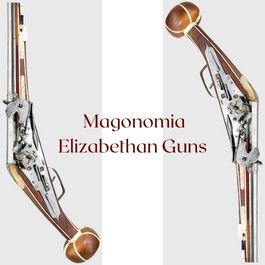
Lets talk Elizabethan guns. Pistols aren’t great in the start of the reign. The problem isn’t range or accuracy, both of which are bad, but they still trump swords and daggers in close combat, so that gives them a use case, the problem is the trigger mechanism. Early pistols are matchlocks. Time for some engineering.
A matchlock pistol has trigger which, when pulled lowers a twisted metal piece, called a serpentine, toward a small pan, which contains gunpowder. A flame on the end of the serpentine ignites the powder in the pan. The flame goes through a small hole in the end of the pan to the barrel, ignites the powder within, and forces the ball explosively forward.
So, there are many problems here. The first is, how do I light the flame at the end of my serpentine? The method that has evolved is to clamp a piece of slow-burning, chemical-permeated rope, which is referred to as “match”, at the serpentine’s end. Slowmatch burns at about a foot an hour, so if you have plenty of match and some warning, you can ready your gun in advance. That being said, permanent readiness is expensive: a sentry can go through a mile of match in a year. Some people who do not want to be caught suddenly in a firefight keep a case with a piece of slowmatch in it, so they can use it to light the one already clamped to the top of their pistol. Coachmen, for example.
This arrangement is less useful for covert action than it initially appears. The ember at the end of the match is very visible at night. Slowmatch causes smoke and has a distinctive smell. later, the pirate Blackbeard used to tie bits of burning match to himself before battle, to appear infernal. A related problem is that the powder is the pan is exposed: it can fall out if the gun is jostled, and if the weather is wet, or even humid, it can fail to light. As a spy, it’s all very well to have a gun and a slowmatch case, but being smoky, smelly and having to keep your gun upright, or load it before shooting at someone, is all kinds of impractical.
The spell “Spark of Magic” (Core rules p. 230) gets around the lighting problem by providing you with an intelligent fire sprite you can direct. You need to keep the fire sprite in a clay jar, and I’d personally work that into the handle or stock of my firearm. It also lets you play merry heck with the following some kinds of guns listed later, if you assume the sprite is strong enough to lift the pan covers on guns. The rules say it can cause misfires, but it doesn’t emphasise that the problem with misfires aren’t just that the shot is wasted, its that if the sprite is patient or can tip the barrel slightly, the shot likely goes into your leg, or the shoulder of your horse. There are safety features on many of the following guns, but they work by preventing flint, steel and powder coming together. The fire sprite bypasses that.
Enter the wheellock, and this all changes. The wheellock appears about 1500, so it is well known in the reign. The being said wheel locks are double the cost of matchlocks and are fragile, so they aren’t used on campaign, save as cavalry and officer sidearms. They are used in some early assassinations though, and there are a few court cases where people accidentally kill their victims because they think the gun is safe, because there is no burning match.
When you pull the trigger of a wheel lock, a hardened steel wheel on a spring begins to spin within the pan. The serpentine drops a chunk of pyrite onto the wheel, and it sprays sparks downward onto the pan. Cleverly, the pan also often has a cover which is retracted by the trigger mechanism. You can, in short, have a pocket full of death. You don’t smoke, smell or need to fear the rain. Reloading requires a weird sort of key to wind the spring on the wheel, but if you are an assassin, you only get one shot with surprise: it’s still as loud as a matchlock. Carry more than one, if you like.
One odd feature is that when you hold a wheel lock, it works slightly better if you tilt it off vertical. This is because the sparks off the wheel are gravity-fed to the pan. If the sparks fall to the side of the wheel, rather than at the foot of the wheel, they hit more of the powder in the pan. By tilting the gun slightly you make that offset.
The fix for the problems of the wheellock, the snaplock, appears early in the Reign, roughly 1540. Basically in a snaplock the serpentine is replaced by a differently shaped bit of metal called a cock, tipped with a piece of flint. The trigger releases a spring, so that the cock moves forward, pushing the flint along a bit of curved steel, spraying sparks downwards into the pan. You don’t need to pull out a sort of Renaissance Allen key to reload. It costs about 50% more than a matchlock, which is substantially les than a wheel lock. Many have little, manual, pan covers so you can shove them in your pants and swing on ropes, pirate style, and they probably won’t either go off or spill their powder. The pan does not, however, automatically retract: that appears in the next iteration, the snaphance, which is popular after 1560. True flintlocks appear after 1610. Their main feature is that the striking steel and pan cover are a single piece of metal. That being said, people in the period don’t use our modern terms. Spanish people call all of the flinty things “rake locks” for most of the period.
There is another intermediate form, the miquelet, which is popular in Spain and Italy late in the Reign. It’s called the Mediterranean lock in English for a while. Its presence in London is innately suspicious.
)
 Games From Folktales