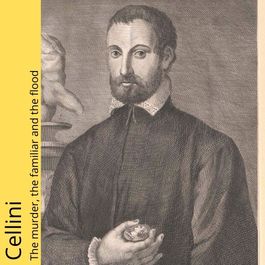
In the section which follows, note that everyone is embarrassed to have captured a murderer. They live in an honour culture, rather than a legal culture, and so it seems to them that they are acting unjustly, at least according to the biased narrator.
LI
I WENT on applying myself with the utmost diligence upon the gold-work for Pope Clement’s button. He was very eager to have it, and used to send for me two or three times a week, in order to inspect it; and his delight in the work always increased. Often would he rebuke and scold me, as it were, for the great grief in which my brother’s loss had plunged me; and one day, observing me more downcast and out of trim than was proper, he cried aloud: “Benvenuto, oh! I did not know that you were mad. Have you only just learned that there is no remedy against death? One would think that you were trying to run after him.” When I left the presence, I continued working at the jewel and the dies for the Mint; but I also took to watching the arquebusier who shot my brother, as though he had been a girl I was in love with. The man had formerly been in the light cavalry, but afterwards had joined the arquebusiers as one of the Bargello’s corporals; and what increased my rage was that he had used these boastful words: “If it had not been for me, who killed that brave young man, the least trifle of delay would have resulted in his putting us all to flight with great disaster.” When I saw that the fever caused by always seeing him about was depriving me of sleep and appetite, and was bringing me by degrees to sorry plight, I overcame my repugnance to so low and not quite praiseworthy an enterprise, and made my mind up one evening to rid myself of the torment. The fellow lived in a house near a place called Torre Sanguigua, next door to the lodging of one of the most fashionable courtesans in Rome, named Signora Antea. It had just struck twenty-four, and he was standing at the house-door, with his sword in hand, having risen from supper. With great address I stole up to him, holding a large Pistojan dagger, and dealt him a back-handed stroke, with which I meant to cut his head clean off; but as he turned round very suddenly, the blow fell upon the point of his left shoulder and broke the bone. He sprang up, dropped his sword, half-stunned with the great pain, and took to flight. I followed after, and in four steps caught him up, when I lifted my dagger above his head, which he was holding very low, and hit him in the back exactly at the juncture of the nape-bone and the neck. The poniard entered this point so deep into the bone, that, though I used all my strength to pull it out, I was not able. For just at that moment four soldiers with drawn swords sprang out from Antea’s lodging, and obliged me to set hand to my own sword to defend my life. Leaving the poniard then, I made off, and fearing I might be recognised, took refuge in the palace of Duke Alessandro, which was between Piazza Navona and the Rotunda. On my arrival, I asked to see the Duke; who told me that, if I was alone, I need only keep quiet and have no further anxiety, but to go on working at the jewel which the Pope had set his heart on, and stay eight days indoors. He gave this advice the more securely, because the soldiers had now arrived who interrupted the completion of my deed; they held the dagger in their hand, and were relating how the matter happened, and the great trouble they had to pull the weapon from the neck and head-bone of the man, whose name they did not know. Just then Giovan Bandini came up, and said to them. “That poniard is mine, and I lent it to Benvenuto, who was bent on revenging his brother.” The soldiers were profuse in their expressions of regret at having interrupted me, although my vengeance had been amply satisfied.
More than eight days elapsed, and the Pope did not send for me according to his custom. Afterwards he summoned me through his chamberlain, the Bolognese nobleman I have already mentioned, who let me, in his own modest manner, understand that his Holiness knew all, but was very well inclined toward me, and that I had only to mind my work and keep quiet. When we reached the presence, the Pope cast so menacing a glance towards me, that the mere look of his eyes made me tremble. Afterwards, upon examining my work his countenance cleared, and he began to praise me beyond measure, saying that I had done a vast amount in a short time. Then, looking me straight in the face, he added: “Now that you are cured, Benvenuto, take heed how you live.” I, who understood his meaning, promised that I would. Immediately upon this, I opened a very fine shop in the Banchi, opposite Raffaello, and there I finished the jewel after the lapse of a few months.
In this chapter we meet Cellini’s familiar, we see that the papal court is terribly gossipy, and learn of a time where people are wandering around Rome with pockets full of jewels.
LII
THE POPE had sent me all those precious stones, except the diamond, which was pawned to certain Genoese bankers for some pressing need he had of money. The rest were in my custody, together with a model of the diamond. I had five excellent journeymen, and in addition to the great piece, I was engaged on several jobs; so that my shop contained property of much value in jewels, gems, and gold and silver. I kept a shaggy dog, very big and handsome, which Duke Alessandro gave me; the beast was capital as a retriever, since he brought me every sort of birds and game I shot, but he also served most admirably for a watchdog. It happened, as was natural at the age of twenty-nine, that I had taken into my service a girl of great beauty and grace, whom I used as a model in my art, and who was also complaisant of her personal favours to me. Such being the case, I occupied an apartment far away from my workmen’s rooms, as well as from the shop; and this communicated by a little dark passage with the maid’s bedroom. I used frequently to pass the night with her; and though I sleep as lightly as ever yet did man upon this earth, yet, after indulgence in sexual pleasure, my slumber is sometimes very deep and heavy.
So it chanced one night: for I must say that a thief, under the pretext of being a goldsmith, had spied on me, and cast his eyes upon the precious stones, and made a plan to steal them. Well, then, this fellow broke into the shop, where he found a quantity of little things in gold and silver. He was engaged in bursting open certain boxes to get at the jewels he had noticed, when my dog jumped upon him, and put him to much trouble to defend himself with his sword. The dog, unable to grapple with an armed man, ran several times through the house, and rushed into the rooms of the journeymen, which had been left open because of the great heat. When he found they paid no heed to his loud barking, he dragged their bed-clothes off; and when they still heard nothing, he pulled first one and then another by the arm till he roused them, and, barking furiously, ran before to show them where he wanted them to go. At last it became clear that they refused to follow; for the traitors, cross at being disturbed, threw stones and sticks at him; and this they could well do, for I had ordered them to keep all night a lamp alight there; and in the end they shut their rooms tight; so the dog, abandoning all hope of aid from such rascals, set out alone again on his adventure. He ran down, and not finding the thief in the shop, flew after him. When he got at him, he tore the cape off his back. It would have gone hard with the fellow had he not called for help to certain tailors, praying them for God’s sake to save him from a mad dog; and they, believing what he said, jumped out and drove the dog off with much trouble.
After sunrise my workmen went into the shop, and saw that it had been broken open and all the boxes smashed. They began to scream at the top of their voices: “Ah, woe is me! Ah, woe is me!” The clamour woke me, and I rushed out in a panic. Appearing thus before them, they cried out: “Alas to us! for we have been robbed by some one, who has broken and borne everything away!” These words wrought so forcibly upon my mind that I dared not go to my big chest and look if it still held the jewels of the Pope. So intense was the anxiety, that I seemed to lose my eyesight, and told them they themselves must unlock the chest, and see how many of the Pope’s gems were missing. The fellow were all of them in their shirts; and when, on opening the chest, they saw the precious stones and my work with them, they took heart of joy and shouted: “There is no harm done; your piece and all the stones are here; but the thief has left us naked to the shirt, because last night, by reason of the burning heat, we took our clothes off in the shop and left them here.” Recovering my senses, I thanked God, and said: “Go and get yourselves new suits of clothes; I will pay when I hear at leisure how the whole thing happened.” What caused me the most pain, and made me lose my senses, and take fright-so contrary to my real nature-was the dread lest peradventure folk should fancy I had trumped a story of the robber up to steal the jewels. It had already been paid to Pope Clement by one of his most trusted servants, and by others, that is, by Francesco del Nero, Zana de’ Biliotti his accountant, the Bishop of Vasona, and several such men: “Why, most blessed Father, do you confide gems of that vast value to a young fellow, who is all fire, more passionate for arms than for his art, and not yet thirty years of age?” The Pope asked in answer if any one of them knew that I had done aught to justify such suspicions. Whereto Francesco del Nero, his treasurer, replied: “No, most blessed Father, because he has not as yet had an opportunity. “Whereto the Pope rejoined: “I regard him as a thoroughly honest man; and if I saw with my own eyes some crime he had committed, I should not believe it.” This was the man who caused me the greatest torment, and who suddenly came up before my mind.
After telling the young men to provide themselves with fresh clothes, I took my piece, together with the gems, setting them as well as I could in their proper places, and went off at once with them to the Pope. Francesco del Nero had already told him something of the trouble in my shop, and had put suspicions in his head. So then, taking the thing rather ill than otherwise, he shot a furious glance upon me, and cried haughtily: “What have you come to do here? What is up?” “Here are all your precious stones, and not one of them is missing.” At this the Pope’s face cleared, and he said: “So then, you’re welcome.” I showed him the piece, and while he was inspecting it, I related to him the whole story of the thief and of my agony, and what had been my greatest trouble in the matter. During this speech, he oftentimes turned round to look me sharply in the eyes; and Francesco del Nero being also in the presence, this seemed to make him half sorry that he had not guessed the truth. At last, breaking into laughter at the long tale I was telling, he sent me off with these words: “Go, and take heed to be an honest man, as indeed I know that you are.”
LIV
ON that very day, as I was passing through the Piazza Navona, and had my fine retriever with me, just when we came opposite the gate of the Bargello, my dog flew barking loudly inside the door upon a youth, who had been arrested at the suit of a man called Donnino (a goldsmith from Parma, and a former pupil of Caradosso), on the charge of having robbed him. The dog strove so violently to tear the fellow to pieces, that the constables were moved to pity. It so happened that he was pleading his own cause with boldness, and Donnino had not evidence enough to support the accusation; and what was more, one of the corporals of the guard, a Genoese, was a friend of the young man’s father. The upshot was that, what with the dog and with those other circumstances, they were on the point of releasing their prisoner. When I came up, the dog had lost all fear of sword or staves, and was flying once more at the young man; so they told me if I did not call the brute off they would kill him. I held him back as well as I was able; but just then the fellow, in the act of readjusting his cape, let fall some paper packets from the hood, which Donnino recognised as his property. I too recognised a little ring; whereupon I called out. “This is the thief who broke into my shop and robbed it; and therefore my dog knows him;” then I loosed the dog, who flew again upon the robber. On this the fellow craved for mercy, promising to give back whatever he possessed of mine. When I had secured the dog, he proceeded to restore the gold and silver and the rings which he had stolen from me, and twenty-five crowns in addition. Then he cried once more to me for pity. I told him to make his peace with God, for I should do him neither good nor evil. So I returned to my business; and a few days afterwards…the Genoese thief was hanged in the Campo di Fiore, while I remained in better repute as an honest man than I had enjoyed before.
LV
WHEN I had nearly finished my piece, there happened that terrible inundation which flooded the whole of Rome. I waited to see what would happen; the day was well-nigh spent, for the clocks struck twenty-two and the water went on rising formidably. Now the front of my house and shop faced the Banchi, but the back was several yards higher, because it turned toward Monte Giordano; accordingly, bethinking me first of my own safety and in the next place of my honour, I filled my pockets with the jewels, and gave the gold-piece into the custody of my workmen, and then descended barefoot from the back-windows, and waded as well as I could until I reached Monte Cavallo. There I sought out Messer Giovanni Gaddi, clerk of the Camera, and Bastiano Veneziano, the painter. To the former I confided the precious stones, to keep in safety: he had the same regard for me as though I had been his brother. A few days later, when the rage of the river was spent, I returned to my workshop, and finished the piece with such good fortune, through God’s grace and my own great industry, that it was held to be the finest masterpiece which had been ever seen in Rome.
When then I took it to the Pope, he was insatiable in praising me, and said: “Were I but a wealthy emperor, I would give my Benvenuto as much land as his eyes could survey; yet being nowadays but needy bankrupt potentates, we will at any rate give him bread enough to satisfy his modest wishes.” I let the Pope run on to the end of his rhodomontade, and then asked him for a mace-bearer’s place which happened to be vacant. He replied that he would grant me something of far greater consequence. I begged his Holiness to bestow this little thing on me meanwhile by way of earnest. He began to laugh, and said he was willing, but that he did not wish me to serve, and that I must make some arrangement with the other mace-bearers to be exempted. He would allow them through me a certain favour, for which they had already petitioned, namely, the right of recovering their fees at law. This was accordingly done, and that mace-bearer’s office brought me in little less than 200 crowns a year.
 Games From Folktales