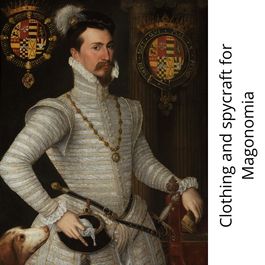
I started to write an article on trick gadgets for Magonomia, but I need to step back a little and give some basic information. Much as I’d need to explain what a cummerbund was if writing up James Bond’s gear, I need to define some terms as we go through, so the potential of clothing being tricked out becomes obvious. I’d like to mark this is very basic material, and suggest if you want to wade in, there’s a brilliant page at http://www.elizabethancostume.net/ which will let you fill your boots.
First, be aware that Elizabethans try not to launder their fancier clothes. Every time you launder your clothes you are damaging them, and costing yourself money. This is why all of the clothes you’ll see below have really extensive sets of undecorated undergarments. You can launder those without much worry, and you can replace them far more easily than outerwear. Similarly, you’ll see that the collars and sleeves of many garments come off. That’s so that you can launder and replace them without damaging the expensive panels of outer fabric. Strangely this doesn’t make them as stinky as you’d imagine. This is why the Queen, her favourites, and faeries wear white linen clothes: it’s a sign of ridiculous wealth.
Let’s start at the head.
Every woman wears something that covers her hair, for the sake of modesty. At its simplest. this a coif. A coif is a cloth cap which has a supporting wire, or layer of stiffened fabric, at the hairline. Coifs are wool, unless your husband is very rich, in which case you might be allowed silk. That front band of the coif gives us some potential for mischief: for example the wire there could be used as a lockpick. The front band could be used to smuggle a small note. Generally though the coif is too tight to hide much The coif also acts as an undergarment for a hood..
Hoods tend to be worn by better-off women. There has been a relatively recent change in fashion, early in the reign, so that older, conservative women wear the English (or “gable”) hood and younger women, or the more courtly, wear French hoods. I’d suggest if you have magic items to protect or extend the mind, made for women, the recent change in fashion means they are more likely to be the older style than the newer. The gable hood looks like a little box or house on the head, and has panels which might be decorated. The sides are called lappets. A French hood is the one you are used to seeing in the art of the time: it allows you to see the front of the hair (which was considered a bit racy). It gets smaller and worn further back over time. There’s a black veil on the back of a French hood, and on the back of the late gable hoods there are two tubes of fabric that flow down the back in a v shape, but can be pinned in various ways to make headdresses. One little variation is the XX hood, which is like a French hood, but has a sort of heart shape to the line above the brow. Mary Queen of Scots used to rock these,
The snoods you see at Renaissance fairs are, sadly, not of the period. Then again, I’m not going to knock down your door with a warrant from the Fashion Police, Renaissance Branch.
Lower class men wear coifs, generally black, but these are supplemented by a flat hat. By law you need to wear a woollen one to church on Sunday, to keep the wool price up. Hats are worn both indoors and out, but at home you might just wear a sort of trinagular sleeve that looks like a Victorian nightcap. Rich men have flat hats, but as time goes on they start getting a more structure and height, becoming very tall by the end of the reign. They have jewels or feathers as an ornaments.
Hair is worn short and parted at the centre for much of the reign. Wigs are common, but they are not powdered white at this stage. Styles get longer as the reign continues. Early on, the habit of plucking or shaving the hairline to make the brow look taller was common, but late in the reign bangs come in. A brief word on beards: once starch becomes easily available, it lets men work on all kinds of weird beards. One I’d note in particular is the spade beard, which was though very martial.
Make up is used by both sexes. Basically, your goal is to look like the Queen. Well, not the actual Queen, the official queen. So, young, flawless and very pale. Basically try not to look Spanish. This is why when you look at portraits of Lord Dudley he looks like the Queen’s brother. The main weapon in looking flawless is white paint called ceruse, which is made of a mixture of lead and vinegar. Its so toxic it’ll give you boils and if you swallow enough it drives you mad, then kills you. Some people are also bled to get rid of redness in their faces. Other substances were used to add blush and redden lips. Kohl was used to outline the eyes. Fingernails are polished with a mixture of blood and pig fat, which smells about as bad as you imagine. Men paint out their bald spots or wear wigs – hairlessness is seen as a symptom of sickness.
The Trunk
To oversimplify: the basic clothes for women start with a linen smock. Then a petticoat is added. This is usually linked to a bodice, which laced at the side, or in a spiral up the back. The French and Italians did have front-lacing bodices, so if you want one, just be fashion forward. Above this is a gown which is open enough that the petticoat is visible beneath at the neck, and is short enough so the edges of the petticoat are visible at the base. These visible bits are more heavily decorated than the rest. In some cases, there’s an extra, triangular, garment is added to the neck area, called a partlet, to make that look more expensive. Partlets and matching sleeves are mentioned as Chrismas gifts.
The skirt’s shape, in noble women, is guided by a hoop frame called a farthingale. This can be made of reeds or baleen. Over this is worn a riding cloak, if needed. In Ars Magica, metal rings are really useful for certain types of magic, so I wanted to note that a farthingale hoop counts and is rather larger than most of the rings available to the well-dressed courtier.
Men’s garments start with a shirt (linen for rich guys) and over that is worn a doublet. This can have boning in it to help men have the desired shape. Doublets have sleeves that, in some cases, are only laced on so they can be removed for separate laundering. Over this a jerkin might be worn. The jerkin is a sort of sleeveless vest. Doublets and jerkins become brighter as the reign goes on, as rich fabrics and dyes are a sign of status. The waist of these garments form a V shape that points toward the genitals. The structured garments reinforce this shape. Late in the reign the peascod belly becomes fashionable. This is a pad that makes the man look fat and thus opulent. You could argue that it’s not to make you look fat, it is to copy the cut of a an armoured chestplate.
Outside all of this, in wet weather, you’d wear a hooded cloak. The lengths vary, but people riding long distances use ankle length ones, and women have stays which tied to their shoes, so stop the cloak flaring. Cloaks for daywear are more ornamental, have wider shoulders, and can be as short as the groin. Most are between the knee and ankle.
On the way through we’ve skipped the ruff. Ruffs are, in essence, a detachable collar. They are also, in a slight way, a posture trainer: when you are wearing one you need to keep your neck raised and stare down your nose at people. They become popular once a Dutch immigrant brings over the techniques for making starch in commercial quantities. We often think of them as white, but blue was also a popular colour. Poor people do not wear ruffs, because they are both silly and expensive. Ruffled cuffs match the neck ruff, and similarly are not for people who actually do things with their hands.
While discussing things poor people do not wear, I was surprised to learn that the Venetian moretta has a parent in England. Rich women going horse-riding wear a black velvet mask to prevent facial tanning. These “vizards” are held in place by clamping a bead in the mouth, but unlike the moretta, they have a mouth hole, and it’s possible to speak while using one.
People wear woollen stockings held in place with ribbon garters. These are called “hose” but they don’t necessarily join at the top like modern pantyhose. For men, assume they wear hose on the lower legs and, over them, breeches at the top of the legs. The fashion here changes a heap, but in Elizabeth’s time, assume that courtiers have long hose and tiny shorts. The Queen knows what she likes. For men, when the doublet is short, there’s an extra flap or pouch, called a codpiece, which holds or hides the genitals. Some men wear two different coloured hose, or hose which have stripped panes of colour. These are called pansied hose and draw attention to how hot your legs are. In the upper class, this is almost exclusively a guy thing. Venetian hose are odd in that they have pockets in the seams. People don’t expect it, so…good place to hide stuff.
People wear boots in the muck and slippers indoors. Men wear shoes a bit more because they are out and about. Shoes tie over the instep.
Accessories.
Rich people wear gloves – poor people do not unless it is for warmth, and that’s more of a mitten situation. The problem with gloves is people can’t see the cool rings you have on your fingers, so, cut-off gloves are used later by some people.
Folding fans are a late thing – the fans they have earlier are made, by preference, of ostrich feathers which are imported from North Africa. People wear sables, called “flea furs” by people into costumery, and I’m not sure where that name comes form.
Women wear earrings. Men wear single earrings, but I’m not sure if that’s considered a naval thing yet. Some put a line of black fabric through their ear instead.
I can’t see any note, in my shallow search, about waist belts, but Dudley is wearing one in his favourite portrait. I do see men having baldrics which are a sort of shoulder strap. It can be used to hold a sword, but it can also support pouches and tools. It could also hold a brace of pistols, but the legalities there are tricky and need their own post eventually. After the assassinations of Moray in Scotland (1570) and William the Silent in Holland (1584) the Queen’s court freaks out about assassins getting close to Elizabeth with a pistol. Legally you can only carry one if you have an income of 100 pounds a year, and the barrel is at least a yard long. That being said, the law’s enforcement away from the Queen is terrible, and no sensible person would ride the countryside without obviously having a brace of pistols. You need several because you don’t want to have to reload in battle.
 Games From Folktales