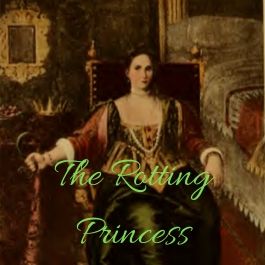
Have you heard the story of the rotting princess? She usually gets a paragraph in the histories of Venice. Just a small one, near the beginning. She’s a useful starting point. She’s where you can say things started to careen off course. She’s to blame for all of the vanities of Venice.
She was an imperial princess from Constantinople. She demanded the pomp of her father’s court. She bathed in dew. She invented the custom of Venetians wearing scented gloves, and had her rooms smoked with incense before she entered them. The Venitian love of cosmetics is her legacy, and their habit of having social gatherings in the shops of perfumers. Worst and most delicate of all, and this is tellingly stated by historians, she was too delicate to eat with hwer fingers and insisted on using a tiny golden instrument, with two prongs, to lift food to her mouth.
For her vanity she was blasted by God, to rot and yet not die. To be a horror so foul, in form and odour, that no person could be near her. She languished in a nunnery. All the riches of Venice were offered to anyone who could cure her, and yet no mortal science could take away her pain, or her shame.
The main history you may have read can’t be right. There weren’t a lot of princesses who became dogaressa, and so the story has tended to stick to one: Teodora Selvo, but it was first recorded before she took the mantle. Who knows then, who she was? Perhaps Maria Argyropoulina, who was wed to the doge in 1004? It matters little to historians, but it matters to us.
This is where it began.
This is when something happened to Venice.
Something answered her prayers.
Something expelled her demons.
Something took the reward her husband had so rashly offered.
In 2020, we explore the Serene Republic, through the lives of its dogeressas, through the folktales of fabulists, and through the nascent Empire it is demanding from the sea.
Welcome to Serenissima.
 Games From Folktales
It seems really, really hard (in an Ars Magica context) to ignore Guorna the Fetid for this story…
Is this princess a Tytalus maga? Someone else (a non-Hermetic) from Guorna’s tradition? Or…?
I mean… it could be unrelated. But the Hermetic implications just seem so clear…
LikeLike
Yep, clearly there’s something related going on. It’s the first bit of folklore for the new Venice thing, so I don’t want to nail it down yet, but she seems to be the point where Venice suddenly gets colourful and decadent.
LikeLike