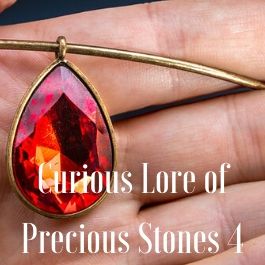
Carbuncle (generally Garnet)
The carbuncle was recommended as a heart stimulant; indeed, so powerful was its action, that the wearers were rendered angry and passionate and were even warned to be on their guard against attacks of apoplexy….In mythical fancies too this stone played its part, for dragon’s eyes were said to be carbuncles.
Rumphius states that in 1687 he was told by a chirurgeon that the latter had seen in the possession of one of the rulers in the island of Amboin a carbuncle said to have been brought by a serpent. The story ran that this ruler, when a child, had been placed by his mother in a hammock attached to two branches of a tree. While there a serpent crept up to him and dropped a stone upon his body. In gratitude for this gift the parents of the child fed and cared for the serpent. The stone is described as having been of a warm yellow hue, verging on red; it shone so brightly at night that a room could be illuminated by it. It eventually passed into the possession of a King of Siam.
The well-formed image of a lion, if engraved on a garnet, will protect and preserve honors and health, cures the wearer of all diseases, brings him honors, and guards him from all perils in travelling.
Carnelian
The wearing of carnelians is recommended by the Lapidario of Alfonso X to those who have a weak voice or are timid in speech, for the warm-colored stone will give them the courage they lack, so that they will speak both boldly and well. This is in accord with the general belief in the stimulating and animating effects produced by red stones.
On a carnelian is engraved in Arabic characters a prayer to keep away evil and to deliver the wearer from all the tricks of the devil and from the envious….Throughout all the East people are afraid of the envious. They believe that if you envy a person for his health or his wealth or any good thing he may have, he will lose it in a short time, and it is the devil who incites the envy of some people against others. So it is supposed that by wearing this stone, bearing this prayer against the envious, their envy will cease to do you harm.
An Armenian writer of the seventeenth century reports that in India the lâl or balas-ruby, if powdered and taken in a potion was believed to banish all dark forebodings and to excite joyous emotions. To the carnelian was attributed a virtue somewhat analogous to that ascribed to the turquoise, as anyone wearing a carnelian was proof against injury from falling houses or walls; the writer emphasizes this by stating that “no man who wore a carnelian was ever found in a collapsed house or beneath a fallen wall.”
Because of the cooling and calming effect exercised by carnelian upon the blood, if worn on the neck or on the finger, it was believed to still all angry passions.
A man with a sword in his hand, on a carnelian, preserves the place where it may be from lightning and tempest, and guards the wearer from vices and enchantments. A man richly dressed and with a beautiful object in his hand, engraved on a carnelian, checks the flow of blood and confers honors.
Garnet: navigation 2, strengthen body and mind 2, vigor 2, bonds of commitment 3, repel insects 4
Chalcedony
An ingenious though far-fetched explanation of the power attributed to chalcedony of driving away phantoms and visions of the night is supplied by Gonelli, writing in 1702. For him the source of this asserted power was to be found in what has been erroneously termed the alkaline quality of the stone. This dissipated the evil humors of the eye, thus removing the diseased condition of that organ which caused the apparitions to be seen. However absurd this explanation may be, it nevertheless shows that the author put little faith in visible ghosts…
Chrysolite
The “Serpent Isle,” in the Red Sea, was stated by Agatharcides to be the source whence came the topaz (chrysolite); here, by the mandate of the Egyptian kings, the inhabitants collected specimens of this stone and delivered them to the gem-cutters for polishing. These simple details are elaborated by Diodorus Siculus into the legend that the island was guarded by jealous watchers who had orders to put to death any unauthorized persons who approached it. Even those who had the right to seek the gem could not see the chrysolite in daytime; only after nightfall was it revealed by its radiance; the seekers then marked well the spot and were able to find the stone on the following day.
From this Egyptian source, and possibly from others exploited by the Egyptians, have come the finest chrysolites (peridots, or olivines), the most magnificent examples of this gem. These found their way into the cathedral treasures of Europe, evidently by loot or trade at the period of the Crusades, and are generally called emeralds. Those most notable are in the Treasury of the Three Magi, in the great “Dom,” or Cathedral at Cologne. Some of these gems are nearly two inches long.
Pliny quotes from Juba the tradition that the topaz (chrysolite) derived its name from the Island of Topazos, in the Red Sea, the first specimen having been brought thence by the procurator Philemon, to Berenice, mother of Ptolemy II, Philadelphus. This monarch is said to have had a statue of his wife Arsinoë made from the stone. If there be any foundation for this latter statement, the precious gift sent by Philemon must have been a mass of fluorspar, or some similar material. More than three hundred years after Pliny’s time, Epiphanius, evidently repeating another version of this tradition, states that the “topaz” was set in the diadem of the “Theban queen.”
Chrysolite (olivine, peridot), to exert its full power, required to be set in gold; worn in this way it dispelled the vague terrors of the night. If, however, it were to be used as a protection from the wiles of evil spirits, the stone had to be pierced and strung on the hair of an ass and then attached to the left arm.
The figure of a falcon, if on a topaz, helps to acquire the goodwill of kings, princes, and magnates.
A vulture, if on a chrysolite, has the power to constrain demons and the winds. It controls demons and prevents them from coming together in the place where the gem may be; it also guards against their importunities. The demons obey the wearer. An ass, if represented on a chrysolite, will give power to prognosticate and predict the future.
A man with his right hand raised aloft, if engraved on a chalcedony, gives success in lawsuits, renders the wearer healthy, gives him safety in his travels and preserves him from all evil chances.
The use of a topaz to cure dimness of vision is strongly recommended by St. Hildegard. To attain the desired end the stone was to be placed in wine and left there for three days and three nights. When retiring to sleep, the patient should rub his eyes with the moistened topaz, so that this moisture lightly touched the eyeball. After the stone had been removed, the wine could be used for five days.
A Roman physician of the fifteenth century was reputed to have wrought many wonderful cures of those stricken by the plague, through touching the plague sores with a topaz which had belonged to two popes, Clement VI and Gregory II. The fact that this particular topaz had been in the hands of two supreme pontiffs must have added much to the faith reposed in the curative powers of the stone by those upon whom it was used, and this faith may really have helped to hasten their recovery.
Peridot: protection against nightmares 3
Topaz: courage 4, leadership 4, pride 4, strength 4, controlling wild beasts 5.
Chrysoprase
Wonderful things are told of the virtue of the chrysoprase, for Volmar states that, if a thief sentenced to be hanged or beheaded should place this stone in his mouth, he would immediately escape from his executioners. Although we are not informed in what way this fortunate result was attained, it seems likely that the stone was believed to make the thief invisible, and thus possessed a virtue often attributed to the opal.
A strange story regarding a magic stone reputed to have been worn by Alexander the Great is related by Albertus Magnus. According to this recital, Alexander, in his battles, wore a “prase” in his girdle. On his return from his Indian campaign, wishing one day to bathe in the Euphrates, he laid aside his girdle, and a serpent bit off the stone and then dropped it into the river.
A bull engraved on a prase is said to give aid against evil spells and to procure the favor of magistrates.
Coral
To still tempests and traverse broad rivers in safety was the privilege of one who bore either red or white coral with him. That this also stanched the flow of blood from a wound, cured madness, and gave wisdom, was said to have been experimentally proved.
Coral, which, for twenty centuries or more was classed among the precious stones, to retain its power as an amulet, must not have been worked, and in Italy only such pieces are valued for this purpose as have been freshly gathered from the sea or have been cast up by the sea on the shore. To exercise all its power against spells, or enchantments, coral must be worn where its brilliant color makes it conspicuous; if, however, it should by accident be broken, the separate pieces have no virtue, and the magic power ceases, as though the spirit dwelling in the coral had fled from its abode. The peasant women are careful to guard the corals they wear for a special purpose from the eyes of their husbands, for the substance is believed to grow pale at certain seasons, regaining its pristine hue after a short interval of time. Indeed, the women believe that the coral shares their indisposition with them. All this serves to show that a kind of vital force is believed to animate the material, gaining or losing in vigor according to certain conditions, and finally disappearing when the form is broken.
Red coral, against demons +10.
 Games From Folktales