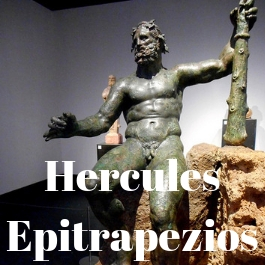
I’ve been listening to a book on the history of art forgery, and it mentions that there are several marble copies of a famous bronze statue, which seems likely to house a Spirit of Artifice or a minor Faerie god in Mythic Europe. An epitrapezios is a statue which, in Classical Greece, was meant to sit in the middle of the table during a feast. It acts as the presiding god, and is worshipped by the process of feasting. In exchange it offers various blessings.
The piece which I was interested in was read into the public domain by Jordan Watts. Thanks to Jordan and all of the Librivox volunteers.
“…The story of this Hercules is told by Martial and Statius, who inform us that it measured a little less than a Roman foot, about nine inches. Notwithstanding its modest dimensions the statuette was modelled with such grandeur and majestic sentiment as to cause Statius to comment, “parvusque videri, sentirique ingens” (small in appearance, but immense in effect). It represented Hercules in a smilingly serene attitude, seated on a rock, holding a club in his right hand and in the other a cup. It was in fact one of those statuettes which Romans called by the Greek word epitrapezios, and which were placed on dining-tables as the genius loci of the repast.
The history of this gem of Sulla’s collection is uncommon, and its vicissitudes most remarkable. The statue was37 originally a gift made by Lysippus to Alexander the Great. This sovereign and conqueror was so attached to Lysippus’ present that he carried the statue with him wherever he went. When dying he indulged in a touching adieu to the cherished statuette.
After Alexander, the little Hercules fell into the hands of another conqueror, Hannibal. It is not known how he came to be the possessor of Lysippus’ work, but it may be explained by the fact that Hannibal, being a collector of art and somewhat of a connoisseur and, above all, as Cornelius Nepos states, a great admirer of Greek art, was a keen-eyed hunter after rarities in art. However, be that as it may, Hannibal seems to have been possessed by the same fancy as Alexander, for he carried the little statue with him on all his peregrinations, and even took it to Bithynia, where, as history informs us, he destroyed himself by poison. At his death the Hercules passed, in all probability, into the hands of Prusias at whose court Hannibal died.
A century later the statue reappeared in Sulla’s collection. Very likely it came into Sulla’s possession as a present from King Nicomedes, who owed gratitude to Sulla for the restitution of the throne of Bithynia.
After Sulla’s death it is difficult to locate this precious statue of his famous collection. Presumably it passed from one collector to another, and never left Rome. “Perhaps,” says Statius, “it found its place in more than one Imperial collection.” The statue reappears officially, however, under Domitian. At this time it is in the possession of the above-quoted Vindex, a Gaul living in Rome, a friend of Martial and Statius and one of the best art connoisseurs of his time.
At Vindex’s death the statuette disappears again, and no mention of it has ever been made since by any writer. What may the fate have been of this chef-d’œuvre of Lysippus which passed from one collection to another for more than four centuries?” – from chapter 3 of The Gentle Art of Faking by Riccardo Nobili.
Plot hooks:
- If Frederick II discovers the existence of this statue, he’ll have agents looking for it. He wants it for the civil war with the German princes, or for crusading.
- House Tremere is not fond of gods, but they don’t want people using one like this. They’d like to gently file it away in a cave somewhere.
- Vindex seems to have been a prince of collectors. The Hercules might not make you a conqueror, unless you want to be. It might just allow you to excel in your field. House Verditius magi are likely to know it exists, and want it, to allow them to defeat their rivals at the House competition.
Image credit: https://www.flickr.com/photos/70125105@N06/42821529352 (CCO)
 Games From Folktales