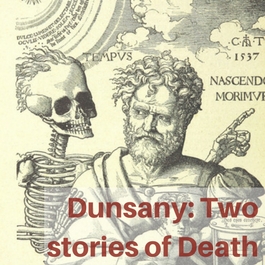
The Grim Reaper doesn’t get much of a look in in Mythic Europe: he’s a later artistic contrivance. The Romans had a God of Death, but the god of the process of dying, sadly for the order, was Hermes himself, in his role as psychopomp. I’ve split off a third story, “Death and the Orange”, for a different week, because I want to write the statistics for a piece of homicide-inducing fruit.
Thanks again to Thomas A. Copeland, the Librivox reader who put these into the public domain.
The Guest
A young man came into an ornate restaurant at eight o’clock in London.
He was alone, but two places had been laid at the table which was reserved for him. He had chosen the dinner very carefully, by letter a week before.
A waiter asked him about the other guest.
“You probably won’t see him till the coffee comes,” the young man told him; so he was served alone.
Those at adjacent tables might have noticed the young man continually addressing the empty chair and carrying on a monologue with it throughout his elaborate dinner.
“I think you knew my father,” he said to it over the soup.
“I sent for you this evening,” he continued, “because I want you to do me a good turn; in fact I must insist on it.”
There was nothing eccentric about the man except for this habit of addressing an empty chair, certainly he was eating as good a dinner as any sane man could wish for.
After the Burgundy had been served he became more voluble in his monologue, not that he spoiled his wine by drinking excessively.
“We have several acquaintances in common,” he said. “I met King Seti a year ago in Thebes. I think he has altered very little since you knew him. I thought his forehead a little low for a king’s. Cheops has left the house that he built for your reception, he must have prepared for you for years and years. I suppose you have seldom been entertained like that. I ordered this dinner over a week ago. I thought then that a lady might have come with me, but as she wouldn’t I’ve asked you. She may not after all be as lovely as Helen of Troy. Was Helen very lovely? Not when you knew her, perhaps. You were lucky in Cleopatra, you must have known her when she was in her prime.
“You never knew the mermaids nor the fairies nor the lovely goddesses of long ago, that’s where we have the best of you.”
He was silent when the waiters came to his table, but rambled merrily on as soon as they left, still turned to the empty chair.
“You know I saw you here in London only the other day. You were on a motor bus going down Ludgate Hill. It was going much too fast. London is a good place. But I shall be glad enough to leave it. It was in London that I met the lady I that was speaking about. If it hadn’t been for London I probably shouldn’t have met her, and if it hadn’t been for London she probably wouldn’t have had so much besides me to amuse her. It cuts both ways.”
He paused once to order coffee, gazing earnestly at the waiter and putting a sovereign in his hand. “Don’t let it be chicory,” said he.
The waiter brought the coffee, and the young man dropped a tabloid of some sort into his cup.
“I don’t suppose you come here very often,” he went on. “Well, you probably want to be going. I haven’t taken you much out of your way, there is plenty for you to do in London.”
Then having drunk his coffee he fell on to the floor by a foot of the empty chair, and a doctor who was dining in the room bent over him and announced to the anxious manager the visible presence of the young man’s guest.
Death and Odysseus
In the Olympian courts Love laughed at Death, because he was unsightly, and because She couldn’t help it, and because he never did anything worth doing, and because She would.
And Death hated being laughed at, and used to brood apart thinking only of his wrongs and of what he could do to end this intolerable treatment.
But one day Death appeared in the courts with an air and They all noticed it. “What are you up to now?” said Love. And Death with some solemnity said to Her: “I am going to frighten Odysseus”; and drawing about him his grey traveller’s cloak went out through the windy door with his jowl turned earthwards.
And he came soon to Ithaca and the hall that Athene knew, and opened the door and saw there famous Odysseus, with his white locks bending close over the fire, trying to warm his hands.
And the wind through the open door blew bitterly on Odysseus.
And Death came up behind him, and suddenly shouted.
And Odysseus went on warming his pale hands.
Then Death came close and began to mouth at him. And after a while Odysseus turned and spoke. And “Well, old servant,” he said, “have your masters been kind to you since I made you work for me round Ilion?”
And Death for some while stood mute, for he thought of the laughter of Love.
Then “Come now,” said Odysseus, “lend me your shoulder,” and he leaning heavily on that bony joint, they went together through the open door.
 Games From Folktales