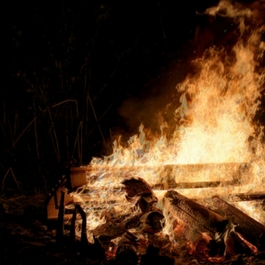
Heraclitus was an ancient Greek philosopher who said everything was made of fire. Why, in Mythic Europe, do the Flambeau not revere him as a spiritual ancestor?
As always for the episodes dealing with philosophers, we begin with an infodump. Heraclitus was a prince from Ephesus in modern Turkey who abdicated to follow a philosopher’s life. His work survives only in fragments quoted in the responses of others. We know he was fond of conundrums. His best known, for example, is that you “cannot step into the same river twice”. The fragmentary nature of his remaining writings makes it unclear if he meant that the water had moved on, or that you, yourself, had changed sufficiently that you would not be capable of doing anything twice. He seems to have believed in an afterlife, and so he must have had some sense of personal continuity, but even at the time, people thought his teachings paradoxical and so the called him “the Obscure”.
When we say that, to Heraclitus, everything is made of fire, we are cheating a little, because he may not have meant what we mean by the word. In the purely mechanical sense he did seem to believe that everything was originally fire, then half of that became water, then half of that became air, then half of that became earth (I may have the order wrong here). In this sense, Fire is the foundational state of nature. If true, this would explain why its easier to hurt people with Creo Ignem spells than other types of created material: it’s not just that fire is hot, so that the human body is fundamentally more vulnerable to it than falling rocks or jets of water. Fire is easier to make, because fire is matter in its most basic form.
What Heraclitus may have meant is that everything is constantly in a state of flux: “flux” may be a better translation of what he meant than actual flame. He believed things were defined by their current state in the dynamic balance between opposing forces. No object embodies a single force, at a single time, ever. “Everything flows. Nothing stands still”
In this, he’s way offside with Plato. There’s none of this World of Forms pressing into matter that he carries on with. An arrow seems still because it is cradled between the forward force of the bowstring and the backward force of the arm. A person is at their current point between birth and death. Everything that appears stable is just made up of a fortunate happenstance of opposing forces. Every individual thing, added together, is just the current state in the universal flux, which is motivated by the universal logos (that is, plan, or word, or design). We have so little of his text we don’t know what he thought the logos was, but some later Christian writers, when they were describing the pre-incarnate Jesus as the fiery Word of God, were cribbing from his symbolism. Justin Martyr, for example, calls him a Christian before Christ.
Heraclitus claimed to be self-taught, and that learning from experience was superior to learning by introspection or instruction. He wrote a book called “On Nature” which was widely available, but is now lost. The first copy of it was in the Artemision, the great temple of Ephesus which was one of the Seven Wonders of the Ancient World. Where it went after the temple’s destruction is not known. The book is believed to have been left incomplete.
The traditional explanation for this is that Heraclitus suffered from depression. There’s a tendency, in Greek and medieval work, to pair him with Democritus, the laughing philosopher. Lucian, who is one of my favourite ancient writers, pairs them. Democritus was absolutely hated by Plato, who wanted to burn his books. This makes him an interesting guy in Ars Magica. Democritus believed philosophers should describe the mechanical processes which underlie events, not the spiritual meaning of events. There’s a reason some people call him the Father of Science.
It may be that Heraclitus’s followers are folded into the Criamon, on their own Path, or more generally. There are elements which sound like the Empedoclean cosmology, with a slightly different terminology. For example, this seems like the Criamon view of time, the Spharios cosmology: “This world, which is the same for all, no one of gods or men has made. But it always was and will be: an ever-living fire, with measures of it kindling, and measures going out.” The fire is the substance and the motivator of existence, much as for Criamon magi, the Spharios is self-caused, and contains within itself the conditions which lead to time.
Heraclitus believed that since all things are decaying, all the time, there is a force of destruction, which he calls “strife” much as the Criamon do. His balancing force is called “justice”, rather than “love”. He departs from the Criamon in that he thinks wisdom can be found in the common person, rather than in a sort of hothouse think-tank. Then again, the Criamon are building something: they are not so much seeking self-improvement as seeking the skills required for a project of cosmological engineering.
The standard Platoic theory of objects is that they exist, and that by observing them at different times, you can see any change in them. Heraclitus believed they never “are” in this sense, but are constantly in a state of becoming, governed by the creative and destructive tensions they embody. Might this be part of the philosophy of the followers of Apromor, who specialise in destruction magic? If all things are made of a balance of two forces, then it doesn’t seem all that difficult to slightly push one side of that balance.
Plot hooks:
Heraclitus’s work is lost, but was widely distributed and may yet be rediscovered. It may be in book form, or retold by pagan ghosts called up by researchers.
The looting of the Temple of Ephesus sprayed its treasures through the East, but most floated back to Constantinople. The recent looting of the capital may have shaken the original copy of this work loose, or may have revealed clues to the location of other treasures hoarded with it.
Is there a fire tradition in pacifistic House Criamon? Are there mystery initiations which allow fire magic to affect other Forms? If Heraclitus is right, then all matter is Ignem, just ignem that’s hard to affect. If fire is flux, and flux is caused by the shifting balance of Justice and Strife, then flux is Vim. Vim, the radinat force that fuels magic, is, unsurprisingly, the spiritual manifestation of Ignem. Heraclitus also through the soul was made up of a greater soul of wisdom (fire) and a lesser soul of passions (water) which arguably makes Mentem magic into Aquam.
 Games From Folktales