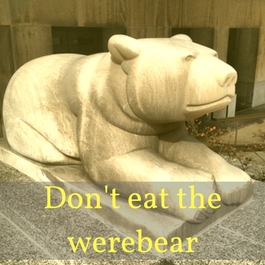
In the Kalevala, the people from the village of the heroes are tormented by the curses of a witch. One is that she sends among them a terrible bear, to harass their herds. He is reffered to as Otso, and the people flatter him in the most extraordinary and duplicitous way.
Vainomoinen, the chief wizard, goes to Otso and points out he cannot defeat him, so he asks Otos’s mercy. He offers Otso all of the comforts of his town. As they approach, there is much singing and rejoicing. The people, as one, chant songs about how they have missed Otso, and how they have cried waiting for the honour of his coming. The bear is taken within the feasting hall, as a guest who is esteemed as a herald of the gods, and who is a lost cousin come home.
This the answer of the tribe-folk:
“We salute thee, mighty Otso,
Honey-paw, we bid thee welcome,
Welcome to our courts and cabins,
Welcome, Light-foot, to our tables
Decorated for thy coming!
We have wished for thee for ages,
Waiting since the days of childhood,
For the notes of Tapio’s bugle,
For the singing of the wood-nymphs,
For the coming of dear Otso,
For the forest gold and silver,
Waiting for the year of plenty,
Longing for it as for summer,
As the shoe waits for the snow-fields,
As the sledge for beaten highways,
As the, maiden for her suitor,
And the wife her husband’s coming;
Sat at evening by the windows,
At the gates have, sat at morning,
Sat for ages at the portals,
Near the granaries in winter, Vanished,
Till the snow-fields warmed and
Till the sails unfurled in joyance,
Till the earth grew green and blossomed,
Thinking all the while as follows:
“Where is our beloved Otso,
Why delays our forest-treasure?
Has he gone to distant Ehstland,
To the upper glens of Suomi?”
—Kalevala – Lonrot Translation
Then they eat him.
In the process, Vainomoinen strips Otso of his characteristics and powers. In one translation he adds these to his own, gaining Otso’s size and strength. It’s unclear if he is literally becoming a werebear during this ritual. In the Lonrott translation this process of removal safeguards Otso’s characteristics so that he does not lose them, as part of the feasting process.
In the end, the people give thanks to the Creator, and ask that a similar feast be sent to them again. Otso is given an air burial, which closely resembles the story of his birth, previously told by Vainomoinen. This may indicate that the bard is aware of the cyclical nature of faeries, and is preparing Otso for return. If this is the case, the keeping of his sensory organs, which presumably contain vis, is necessary for his rapid regeneration. Damaging them may damage Otso’s material form in its next iteration.
A similar story involves the goat the pulls Thor’s chariot. Thor eats it each night and it is reborn each day, unharmed, until some fool cracks on of its bones to get the marrow out. Thor’s crippled goat cannot be made whole again, although it can be restored to some degree with a false bone made of a sacred type of wood.
Sometimes in Ars Magica it is unclear why Birna, also called Bjornaer, the werebear, left her own tradition of shapeshifters, fleeing into the protection of the Hermetic Order, and creating a rift that remains until the game;s present day. Now that we know some people festively eat werebears her motives may be more apparent. Even if you don’t accept that Birna was fleeing something like the cauldrons and golden dishes of Vainomoinen, the question reamins as to if this is what is happening at the Gathering of Twelve Yeats. Is this the year of plenty mentioned in the excerpt? Its possible is that a sacred animal is sent to be butchered by the congregants: their power to transform being given to them, or reinforced, by this cyclical process of consumption of a herald from their creator spirit.
On a more material basis: Hermetic magi going into places where this ritual was practices may wish to find the ritual spaces, because it was traditional for the bones of the bear to be displayed n a sacred ossuary so as not to be disturbed.Some commentators of the Kalevala scholars claim these sites have been found and that the skulls in particular are displayed. They may contain vis, and if they have a regenerative property, so that a bear containing vis is drawn to the area, then they are a vis source.
This s is a loose transcript for the most recent podcast episode.
Photo credit: john_voorhees via Foter.com / CC BY
 Games From Folktales
Ozto The Bear, Called The Forest Apple In Song
Faerie Might: 10 (Animal)
Characteristics: Cun +1, Per 0, Pre 0, Com -5, Str +6, Sta +4, Dex +2, Qik 0
Size: +3
Virtues and Flaws: Faerie Beast, Faerie Sight, Faerie Speech,
External Vis, Cognizant within Role, Ferocity (when injured), Giant, Improved Characteristics (x2), Tough, Greedy (minor), Reclusive
Qualities: Aggressive, Extra Natural Weapons (claws), Fast Runner, Grapple, Hardy, Imposing Appearance, Large Claws, Pursuit
Predator, Tough Hide, Mute. Sovereign Ward (is suicidally lulled by songs)
Personality Traits: Brave +3, Slothful +3, Aggressive +2 Reputations: Ferocious (local) 2
Combat:
Claws: Init 0, Attack +13, Defense +9, Damage +10
Teeth: Init 0, Attack +11, Defense +7, Damage +7
Grapple: Init 0, Attack +7, Defense +5, Damage n/a
Soak: +15
Wound Penalties: -1 (1-8), -3 (9-16), -5 (17- 24), Incapacitated (25-33), Dead (34+)
Pretenses: Athletics 3 (sprinting), Awareness 8 (humans), Brawl 6 (claws),
Faerie Speech 5 (songs) Hunt 4 (for mystical auras), Survival 5 (foraging), Swim 3 (against the current)
Vis: 2 pawns Rego, a bear skull. The bear skull grants the Faerie speech and Faerie Sight virtues, as an External Vis source.
Appearance: The bear is a even larger than usual: eight feet tall on his hind legs, and the size of a horse if on all fours. stands over
seven feet tall on its hind legs. He is, if sung to, surprisingly gentle – it is his role to deliver his virtues to the magicians who consumes
him. Otzo’s ritual might, instead, provide strength or longevity, if troupes find those more appealing.
LikeLike